Showing posts with label Writing Advice. Show all posts

Saturday, August 6, 2016

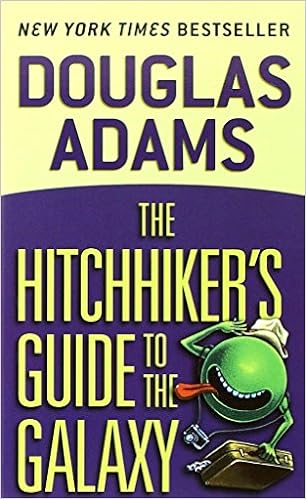
What's Elizabeth Reading? ...Douglas Adams

At the same time my husband and I were in between books in a fantasy trilogy, waiting for the next one to arrive at our library, we were going on vacation. We needed a book, so I chose "The Hitchhiker's Guide to the Galaxy," one he hadn't read yet and one I felt it was culturally imperative that he did. That, and it's a fun book to read.

He was hesitant because he had not enjoyed the latest movie, which I also thought came across as lame. I promised him, and I promise you, that the books are much better.

We finished The Hitchhiker's Guide to the Galaxy (by Douglas Adams, by the way) in half a week. For the record, we only read the first book, not its sequels.

The thing that makes this book a classic in science fiction is the narration, I'm sure of it. I mean, read this beginning:
Far out in the uncharted backwaters of the unfashionable end of the Western Spiral arm of the Galaxy lies a small unregarded yellow sun. Orbiting this at a distance of roughly ninety-eight million miles is an utterly insignificant little blue-green planet whose ape-descended life forms are so amazingly primitive that that they still think digital watches are a pretty neat idea. This planet has--or rather had--a problem, which was this: most of the people living on it were unhappy for pretty much of the time. Many solutions were suggested for this problem, but most of these were largely concerned with the movements of small green pieces of paper, which is odd because on the whole it wasn't the small green pieces of paper that were unhappy. And so the problem remained; lots of people were mean, and most of them were miserable, even the ones with digital watches.
It could be rewritten to be something like this:
There is a small, yellow sun in the western spiral arm of the galaxy, and a little, blue-green planet populated with humans orbited it at ninety-eight million miles. The planet had a problem: Most of the people living on it were unhappy. Many solutions were suggested, but most of them involved money and didn't work. Thus, many of the people were mean, and most of them were miserable.
Which says the same thing, right? It's also shorter, which is supposed to be a good thing, conventionally speaking.

But it's not nearly as interesting or fun to read. Now, each author has their own voice, and that voice can gain an accent, if you will, depending on the genre or the voice of the character, if written in first or third person limited. This is Adams's voice.

I used to have a digital sticky note on my laptop that said "Write like me, and genre will come." My writing should be better if I just sound like me, basically, and I will find stories to tell. Well, I was reading this book and realized that my sass and absurdity may work in my favor if I just let it out like Adams did.
While trying to go to sleep, I gave it some thought. What sort of story would suit a sassy, weird narrator? I wanted the main character to be a regular person, so they could look on the world with the necessary sass and so the absurd things would be even more funny (prime example, Arthur Dent, the book's main character). So in my mind, I invented a 20-something woman who works as an executive assistant (my current day job, easy to use) an a metropolitan area. The next step is to give the character desire. What do they need? Arthur Dent wants normality and for his house not to be bulldozed. Eventually, he just wants to stay alive. My character, I decided, was single and LDS and thus wanted to get married eventually (it's a cultural thing); get a different, better job; and ... here is where I stagnated.

Because those are boring things that would give me a boring, cliche story. What was it that gave The Hitchhiker's Guide to the Galaxy its original spark? The Earth gets blown up.

I couldn't think of a story that would suit a sassy narrator well that didn't involve an inciting incident (event that sparks the plot) that was so devastating it was absurd. Try to think of one and let me know if you can. I couldn't.

Without Earth blowing up, this book would just be characters getting drunk and hating on bureaucracy. Not nearly as fun.

So now we have an executive assistant who is LDS, wants to get married eventually, hates her job, and just had her city bombed during an invasion, with her and her office aquarium fish as the sole survivors. Or she just watched her boss turn into a zombie. Or she's been kidnapped by Tibetan monks and has to fight her way out to safety before the monks or cold get to her.

Then a sassy narrator could really shine.

As for the absurd part, I realized while grocery shopping that stories with absurd events in them have a wild card built into them. Examples: The Heart of Gold in The Hitchhiker's Guide to the Galaxy. The board game in Jumanji. Book magic in Inkheart. Foo in Levan Thumps. The rabbit hole in Alice in Wonderland. The wardrobe in The Lion, The Witch, and the Wardrobe.

The wild card is a prop or gateway thrown in there that allows the author's imagination to run wild. Anything is now possible, thanks to that one item/place/person/thing. The Heart of Gold turns two missiles into a bowl of petunias and a sperm whale. The Jumanji board game sends wild animals through the house and eats Robin Williams. Book magic in Inkheart allows characters to come to life, whichever ones happen to arrive. Thanks to Foo, a living tree is turned into a living toothpick, who then splits farther into the good and evil sides of himself. And we all know about Alice in Wonderland  and Narnia (I like the lamppost in the middle of the forest. That was a nice touch).

I haven't finished thinking about this story, but in case you also think this is a good idea, have at it. You'll need an attitude, some humor, a bizarre inciting incident and a wild card to let your imagination go wherever it pleases.

Best of luck.

Saturday, July 2, 2016

How to Write a Press Release

Remember that post I wrote a couple weeks ago, saying that English classes should teach students how to write things they will actually be writing as adults? This week, I've decided to not be a hypocrite. I usually talk about how to write fiction, but today, I'm going to discuss how to write a press release.

Let us begin with cliche: What is a press release?

Well, inquiring mind, a press release is when an organization -- whether that is a company, club, church group or something else that starts with a "c" -- sends a letter to the media. These days, a press release is also something you could send to your customer base or following. It is meant to disclose whatever has been happening lately in a way that draws attention to your group. Usually, it's happy news, but I suppose tragic news could also warrant a press release.

It is important to note that a news outlet will not publish or use your press release if the news is not interesting or important enough. Saying you got a company pet is not newsworthy, but it would be if said pet works as an on-call seeing eye dog for whoever visits your store. (Can seeing eye dogs switch people, or are they trained for specific people? Unsure.)

News outlets are looking for the following, called "news values": timeliness (last month's news? Forget it), impact (how many people does this affect, and by how much?), prominence (I lied earlier. If Facebook got a company pet, that would make the news), proximity (choose a news outlet in your area, please), interest (how bizarre or heartwarming or sad, basically. The emotion factor), and conflict (who cares if you sold a book? ... Until it gets banned, that is).

When you write a press release, keep these factors in mind. If your news does not fit these categories, I honestly wouldn't even bother. It's important to know your audience, though; a recent press release I had to write said the company I work for had gained membership in an international organization in its field. The local news station couldn't care less, but our customers do care, and they are the ones I sent the release to. It tells customers that we are a bit more legit.

Using that press release as an example, here's how I covered those news values. Timeliness got covered by a photo of a store manager hanging the sign saying it. That makes it seem current. I also used the present tense when talking about the photo. In actuality, the membership started back in January. Impact happened when I said it would help us to better serve our customers and improve the quality of our products. Remember, since the customers were my audience, the question was "How does this impact me?", not the vague, "Who does this impact?" Prominence came in when I labelled the organization as an international one. For some reason, "international" means "important." I also said this was the go-to organization for the industry. I introduced interest by (I hope) going through the organization's code of ethics and giving recent examples (continuing to make it timely!) of how we already uphold it. There were Google reviews to add interest, too, and change up the voice. A press release like this isn't really emotional, but I probably could have worked on this aspect a bit more. As for conflict, there wasn't any. I mean, was I supposed to pretend the organization hadn't wanted us and we had fought our way in? Lesson: You don't need to address all the news values, just all the ones you possibly can.

There is no set length for a press release. I'd say write your news and stop when you've said it all, at a max of two pages. One is better. Don't keep writing for the joy of it, because someone has to read that and all they want is the news, not your life story. They want you to get to the point, answer the who, what, when, where, why and how, and be done.

Please remember to answer those questions. If you leave some of that out, you're missing a crucial part of your story.

Finally, include your contact information and any photos you think would support the story. When I worked at the Press-Tribune, we regularly had people email in a press release (you can mail, email, whatever you want) and then call to make sure we noticed it. This is good practice for dealing with a news outlet.

Best of luck! Google a few examples and you're ready to go.

Saturday, April 23, 2016

Analysis exercise, Alice Munro

Retyping, an exercise in noticing how a writer writes. Today, I'll retype a passage from Nobel Prize winner Alice Munro's "Free Radicals," which was published in "The New Yorker" in February 2008, then analyze it.

This was the cover of the edition it was in.
I love "The New Yorker."
At first, people kept phoning, to make sure that Nita was not too depressed, not too lonely, not eating too little or drinking too much. (She had been such a diligent wine drinker that many forgot that she was now forbidden to drink at all.) She held them off, without sounding nobly grief-stricken or unnaturally cheerful or absent-minded or confused. She said that she didn't need groceries; she was working through what she had on hand. She had enough of her prescription pills and enough stamps for her thank-you notes.

Her closer friends probably suspected the truth--that she was not bothering to eat much and that she threw out any sympathy note she happened to get. She had not even informed the people who lived at a distance, to elicit such notes. Not Rich's ex-wife in Arizona or his semi-estranged brother in Nova Scotia, though those two might have understood, perhaps better than the people near at hand, why she had proceeded with the non-funeral as she had done.

Rich had told her that he was going to the village, to the hardware store. It was around ten o'clock in the morning, and he had just started to paint the railing of the deck. That is, he'd been scraping it to prepare for the painting, and the old scraper had come apart in his hand.

She hadn't had time to wonder about his being late. He'd died bent over the sidewalk sign that stood in front of the hardware store offering a discount on lawnmowers. He hadn't even managed to get into the store. He'd been eighty-one years old and in fine health, aside from some deafness in his right ear. His doctors had checked him over only the week before. Nita was to learn that the recent checkup, the clean bill of health, cropped up in a surprising number of the sudden-death stories that she was now presented with. "You'd almost think that such visits ought to be avoided," she'd said.

If you want to read the full thing, you can, for free, here.

Here is what I noticed. First were the lists in that first paragraph. I could just imagine those phone calls, with people on the phone not knowing what to say. How are you? She gives a short answer. I'd understand if you're depressed, they say. No, I'm fine, thank you, she replies. Would you like some company? I'm sure you're lonely. No, I'm fine, thank you. Et cetera. Awkward conversations on both sides, the sort of conversation that ends in a sigh of relief for them, that they did their duty of reaching out to her, and a sigh of relief for her that they've finally hung up to leave her alone. The use of a list also makes it feel like everyone asks the same set of questions, and she could almost check them off on her fingers as the conversation goes on.

I also noticed the repetition of "too." They obviously expect her to be depressed, lonely, etc., but just want to make sure it isn't serious. Is she fine enough that they don't have to do anything to help? It is as if they are essentially checking to make sure she doesn't commit suicide.

This image went with the story online.
It's attributed to Sam Weber.
Also, the use of the "At first" that the story starts with--it shows that people were interested right after the death, but soon turned their attention to other things (a problem I think we all have, sadly). The phone calls stopped or changed in content before too (haha) long.

As for the "drinking too much" bit, it illustrated, before Munro spelled it out, that these people barely paid attention to her before the death. They didn't know her or care enough to remember that she doesn't drink at all. I'm sure the switch from drinking often to not at all was a life event for her and those people who were truly in her life would have known about it and remembered.

The second list is her list: Don't sound grief-stricken. Don't sound unnaturally cheerful. Don't sound absent-minded or confused. She must be a self-conscious woman who cares about the impression she gives to others. Or she doesn't want to do anything to make them concerned and stay on the line (which is more likely).

Oh, and the "held them off" is a nice touch.

After a public view in the first paragraph, we zoom in to see her actual friends. We get a view of what is actually happening, and we learn her husband's name. I had assumed from the first paragraph that her husband had died, mainly because she was apparently living alone, she was old, and something tragic had happened to her. This is the paragraph where we definitively learn there was a "non-funeral." That comes right after learning she didn't tell the non-family members (telling us she and her husband didn't have much by way of true family, but had lived alone). If they had had true family members, they would have been mentioned in this paragraph.

By the third and fourth paragraphs, we zoom in enough to see what had actually happened. Note the details used, things that symbolically mean little but add reality to the event: He was scraping old paint off the deck when he went to the hardware store and died by a sign out front that was trying to sell lawnmowers. This is not a death she has romanticized at all (a common trait in contemporary fiction).

This may seem like a small detail, but she wrote out "ten o'clock in the morning." There are so many ways to show the time, from the newspaper's "10 a.m." to "10:00 a.m." or "ten in the morning." Contemporarily, people will even just write "10." But no, it's written out here. I'm not sure if that is because of "The New Yorker's" style, but even if it is, writing it out longhand points to her age and temperament. She isn't so anal or grief-stricken as to know the exact minute, or even to know if it was 10:30. She writes out "in the morning," which is not the utilitarian "a.m." and is reminiscent of an older style. People rarely even say "o'clock" anymore, have you noticed?

In a nod to possible symbolism, the old scraper had "come apart in his hand." Practically, it could mean he was having a hard time with the scraping because he's in his 80s. It could also be that the scraper was just old and gave out--like he did.

In that final paragraph I gave you, I love the detail that now everyone is telling her sudden-death stories. This is exactly what happened to me when I last visited my grandma's cousin, who lives near me. I visited to tell her that her brother had died, and at some point in that visit she started telling me stories about how people in our family have a history of simply dropping dead. It was mildly concerning.

I'm sure that people were telling Nita stories about other deaths because they were trying to show they understood. I've noticed that when someone says x happened to them, the people around them start chirping in about how they've had the same experience, except this was how it was different. It must have something to do with a sense of community.

Last comment on the story: "You'd almost think that such visits ought to avoided," Nita says. "Visits" could mean either visits to the doctor or visits to people in mourning. Munro did a nice job of using one word to say two things at once.

I share this analysis for two reasons. 1) It was a good exercise for my reading skills. 2) If you read enough analyses like this, you should be able to do the same thing, and that should improve your writing. Try doing analyses yourself sometime. You'll read more out of what you read.

Saturday, April 9, 2016

Final flash fiction attempt: "Existentialist"

My final flash fiction attempt for the writing contest I entered was the attempt I submitted (and was rejected based on). I originally titled it "Oranges," but switched to something like "Existentialist."
This feels like the perfect night to dress up like hipsters. At least, that’s what everyone else at the Flying M seems to have decided tonight, except me. Me and the woman at the table by the large windows, that is.
She’s wearing a blue dress without sleeves, and she’s been sitting there for over an hour, writing poetry on orange peels with hands decorated by three ring tattoos and veins that are raised rivers, belying an age that is greater than her dress, red purse, or orange peel scrawls.
“It’s as if the trees were whispering,” she’s written on one, a strip discarded near her elbow that I saw on my way to throw out my drink.
A glance out those large, garage door-style windows shows it’s still raining beneath the trees outside, and I wonder what they are trying to say.
But as I wonder, the woman gets up, slipping her oranges into her bag and leaving a tip on the table. I see her step into the evening and stop beneath a sidewalk tree to touch its trunk with one of her river hands, skin like paper and rings like old promises, as if to bid it farewell.
As far as I know, the tree does not answer, but she smiles anyway and it’s a quiet smile, a poet’s smile. She reaches back to free her hair from its clip and it falls in sheets, pulling back in the wind and settling down her back before she turns from the tree and clicks down the sidewalk.
I glance at the hipsters one last time before I check the time and see I should be getting home. On my way to my car, I too stop by the tree and place my hand on its trunk, cold and hard and startlingly white. No words, but perhaps the quiet is a message of its own.
The reason for the title change was an attempt to make this scene more "compelling," which was a criteria it was being judged by. When I wrote this, it was mostly in a poetic frame of mind and I wasn't going for a message in particular beyond "stillness is good."

Found on Livestrong.com. I'm betting she was writing
with a permanent marker.
Deep, I know. I actually purposefully do not try to be profound in my writing, because I think it comes off as sounding stupid a lot of the time.

The writing friend I asked for advice on this piece said something along the lines of, "So the weirdo writes on oranges and touches trees. So what?"

So what, indeed. I did some staring at it and decided it could be considered an existential work. Once something is assigned a philosophy, it automatically gets more credence, right? It's existential because this woman is being her own self and not caring what others think. The narrator is wondering why she is different, and a backdrop of hipsters--a stereotype that loves to philosophize and be individual, yet seeks community and sameness with other hipsters--helps to emphasize how she does not fit a label. (Unless you have an adequate label for an orange-peel poet?)

Does that make it compelling for you? I found it compelling, if only because of the poetic ambiance and beautiful imagery. But then, I'm of the (minority) philosophy that art does not need meaning.

As for dissecting this story, then. The first line was given by the contest organizers, and it reminded me of a local coffee shop, the Flying M Coffeegarage, where small bands often play and people gather to have leisurely conversations. I've had a couple newspaper interviews there, myself, one of them with a philosophy professor who chose the place. I don't know that I have seen hipster-esque people there, but I placed this story there for the hipster environment.

That said, the setting details are correct and true to life, except that I have no idea what trees are outside the place. I doubt there are aspens, which is what I used, but I'm sure I got away with it. I appeal to "Inception," where the girl is told to only use details from actual places, not complete real places.

The woman was in the audience at a reading I attended during the Death Rattle Writers Festival. I took a photo of her, but it didn't do the impression justice, so instead, I wrote this down in my writer's notebook:
And then you see her hands, and the backs of her palms are thin, the bones showing through and the blue of the veins near enough the surface that they could be a raised river and she is old, older than her style of dress or her soda choice or the length of her hair, which reaches down to the bra line in curves. It is brown, and her dress is blue and white and the heels she wears remind me that my mother, not yet fifty, rarely wears high heels. They hurt her feet, she says. Perhaps this woman keeps her age in her hands, arthritis and chafing skin and calloused fingertips, instead of her dress, hair, soda or feet. I keep mine in my shoulders, age counted in 40-hour weeks spent leaning closer to a computer screen.
 Paragraph nonfiction.

Anyway, I borrowed that woman because I was going through my writer's notebooks for ideas and she stood out to me. The ring tattoos come from a student in one of my college classes back in the day--another interesting detail I'd recorded in a writer's notebook. The orange peel poetry was also in my notebook. I have no idea where it came from, but I think I may have stolen it from someone, or else it came from a classmate peeling an orange in English class. Not sure which. But see how useful those notebooks are?!

Note on stealing things in writing: Totally fine, so long as you make it your own. Don't steal wholesale. A guy once tried to borrow pieces of my husband's love poetry to me and mine to him, because he came to us for love poetry advice and we used personal examples. It didn't go well for him. Rang completely false and didn't flow. For the record, that relationship did not last.

Back to the subject at hand. My friend's criticism of the story remains: This story is lacking in conflict. I think it is complete the way it is and would actually like to change the title back to "Oranges." What do you think? Is it compelling? Does it make you care?

Saturday, April 2, 2016

Third flash fiction was like the first all over again

And now for the third flash fiction attempt (I don't know that these got significantly better as I continued on writing them):
Jessie is a friend. At least, I think she is. Candice is a friend and Audrey and Donna and Kate and Sara - but Jessie, I don’t know.
I don’t know because when we stood in line together in the second grade, she only talked to the new girl, who was from Russia and therefore interesting. But that was okay. She gave me a pencil later, one with my name on it, and played wolves with me at recess.
I think Jessie is my friend because in middle school, when my grandma died and I first started hating flowers, she sat on my family’s deep freezer and held my hand.
Jessie is my friend because when I was a high school freshman with a crush on that boy in my geography class, she helped me think of ways to meet him then taught me how to curl my hair into pretty ringlets so he would notice me. And then, when he asked me to be his Facebook friend, she freaked out with me in the parking lot and we went out for frozen yogurt to celebrate.
Jessie was definitely my friend on the day that we graduated. We took photos together and laughed and high-fived our favorite teachers, then went to the after party and, well, and she left with that cute guy she had a thing for. But I know she was my friend because later that night, she called me to tell me what had happened - ALL of it.
But now I don’t know, because Jessie won’t answer the phone when I call, and this year, she forgot my birthday. I need to tell her something.
I need to say I’m pregnant and scared, and I could really use a best friend right now to hold my hand. I am not ready for this.
No, I'm not pregnant (though a friend of mine thinks I should change that. Won't happen soon). This idea came into being while it was being written, and at the end, I realized she needed a reason for her best friend, and pregnancy came to mind.

I wanted to capture that moment—back to that approach—when a woman realizes she is going to be a mother. I am sure it is terrifying, exhilarating and altogether overwhelming.
Raphael Soyer's portrayal of the annunciation.

I love this painting by Raphael Soyer. It's of the annunciation, the moment where an angel comes to the Virgin Mary and says, “Hey, you're pregnant!” I think of it as being just a few minutes after the angel leaves. How was Mary feeling? Probably withdrawn, if nothing else. My mom, if I remember right, thought Mary was the woman in the blue. I think Mary is the one with the purple skirt. Either way, it's a powerful painting.

My flash fiction attempt did not at all measure up to this painted pregnancy moment, but then, it was mostly about someone feeling lonely. I don't know that Mary was feeling lonely quite yet (but later, shunned as a pregnant woman without a husband? I'm sure of it).

This story comes off as a little immature to me. Would you agree? Something about how indecisive she is reminds me of high school. So no, this girl is not ready to be pregnant, in my opinion.

Just like with my first flash fiction attempt, I used glimpsed memories to bring life to a person who is not the narrator. As you can guess, a lot of it is from my own life. I don't think the story sucked the reader in enough to make that work, though. It's more of a cheap trick at this point.

The same stuff I said about the first flash fiction goes for this one, though. It's basically the same story, just with different words and a different oh-you-poor-thing ending.

Lesson learned: Don't put multiple memories in one flash fiction piece, building up to a revelation. That story structure does not work. Why? It doesn't resolve, and the build-up seems contrived, unnatural. I'm not sure why it doesn't seem natural, but both stories rang false.

I don't think I was impressed with this one even when I wrote it. My favorite was the one about the oranges, which I'll go over next week.

Saturday, March 26, 2016

Sundance flash fiction analysis

 My second flash fiction attempt looked like this. In my defense, it was late at night when I wrote it.
“It feels like a perfect night to dress up like hipsters,” the Dorian Gray boy said. Gorgeous, dangerous, met him in a Park City art gallery during Sundance. Surrounded by paintings of mountains, forks bent into stick men, and a bronze Last Supper sitting in front of a window that opened onto an alley, we were the only two in there just then.
It was the stupidest pickup line in the world, not even a pickup line, but I’m too easy and half an hour later saw me making out with him one steep street over in the middle of a looong flight of stairs. I figured it was Sundance. Might as well, right?
But that boy was the stupidest bad-word-my-momma-would-scream-if-she-heard-me-say I have ever met in my life, ‘cause a week later I caught him stealing more than just French fries and trying for more than just French kisses. And by that second part I mean he was trying to go all Bill Clinton all over my butt.
His pants were down and I was telling him no, this was too fast, we only met an hour ago, but man you did pick a pretty spot for this, on top of a mountain and secluded and all, and I respect you for that, and I like your nice car, too, we should just keep driving around in it or something.
That’s when he said, all hot and heavy, that it wasn’t his car, and that’s what I meant about the stealing more than French fries part.
There’s one thing my momma taught me that is the truest thing I have ever known: If you don’t want a man making love to you, pee on him.
After that, he jumped back enough for me to reach past him and open the door. He’d been leaning on that door then and so he lost his balance and fell out.
So yeah, I pushed him down the mountain. With his pants down.
Snow is pretty good for sliding on, especially when it’s steep and the snow is the dry sort that won’t stick together.
I drove away before I could see how far he went, though, and that’s a shame because it would’ve been hilarious on my Instagram. But at the time, I was more concerned about whether to return the car before or after cleaning up the pee in the back seat. Sundance problems.
Here's what I was trying to do: First, I wanted to write an actual story, not just a moment like I wrote last time. I put in a smaller haiku turn, with the wow-she-just-did-that ending, but it was not such a jarring turn as before.

This story idea actually began with a tactic I saw another author use: alluding to something and then building on that allusion. I think I saw it in the short story "The Tik Tok Man," which referenced "1984" and basically said that was the world the story was set in. It is a brilliant tactic because you use tons of work done already and don't have to waste that time yourself. I attempted to copy it by calling the guy a "Dorian Gray boy," but then threw those benefits out the window by explaining it - gorgeous, dangerous. Sure, that might have more depth for someone familiar with "The Picture of Dorian Gray," but there is not much to add. I did not pull all I could have put of a tactic like this. I will have to try again sometime.

I used the Sundance Film Festival partly because I am familiar with it and partially because the first line I was using, one of the assigned possibilities, reminded me of it. Hipsters and Sundance go together. The art gallery they are in is a compilation of art galleries on Park City Main Street, a Sundance location, and the long staircase is another real detail I added in.

I threw this piece out because I did not think it was compelling. Outrageous, yes, but not compelling, and that was one of the characteristics the writing contest judges were looking for.

My writer friend who looked over it for me said the story was all over the place and needed simplification. She also said the descriptions didn't quite convey the feelings or the plot , and I totally agree. I knew this needed editing, if only to unify the voice, which is not consistent. I think that is where her details comment came from. The beginning is more poetic and the end was crude. As for simplofication, I think a unified voice would have made it seem less jumbled and chaotic.

Your thoughts? How could I have improved this?

Saturday, March 19, 2016

Flash fiction retrospect - Jessie the traveller

As a review from last week: I entered a flash fiction writing contest, and I didn't win (whoops, I didn't mention that part earlier, did I?). I went through four different attempts. For my edification and yours, I thought I'd go through them one by one saying what I tried to do, what worked, and what didn't work. Here's the first one:
Jessie is a friend. He is one of those do-everything types, the only person I’ve known who took a break from college to work on a cruise ship and see the world. Every day on Facebook, it was something different -- “Just me and Big Ben, no biggie,” “Bike tour in Puerto Rico. My legs are killing me.” “Sometimes I practice my studious look, but only when I am brooding over my kingdom from a castle in Ireland.” “Couscous! In Morocco!”
Back in high school, Jessie and I took driver’s ed together. The teacher was the same guy who had taught my aunt, so that was weird, but whatever. I remember the first time Jessie got behind the wheel, he had to ask the teacher what a green light meant. I’m serious. The teacher just laughed at him, like it was a joke, but when we got to a light and Jessie gunned it on accident the moment yellow turned to red, man, I thought we were all going to die.
When he got back, from the cruise ship, you know, we had one of those late night talks, the kind that start in a restaurant, then continue in the parking lot for an hour before finishing in someone’s basement when one of you falls asleep. Jessie could tell stories like none other. Dramatic pauses, sound effects, hand gestures. You ever known a storyteller like that?
I’d love to hear one of those again.
I just can’t pull myself out of bed today. Even when someone is physically gone, it’s different from when they’re gone gone. And my heart is too still to beat right now.
It’s like with the blankets over my head, I can pretend the world smaller.
Dear God, help me out of bed today. Please. I need your help.
First off, this piece includes several pieces of real people from my life. I have a friend who temporarily dropped out of college to work on a cruise ship, my aunt had the same teacher as me in driver's ed, that teacher had a story about a kid who didn't know what a red light meant, I love long talks and have had some similar to this, and my father-in-law is that sort of storyteller. The last bit is real, too; it's how I felt when a friend of mine died in college, and again when an old roommate of mine died more recently.

I injected this thing with reality in an attempt to make it seem real. As another gambit for realism, I gave it concrete details, namely the Facebook statuses and the driver's ed story. Concrete details are a secret to good fiction. You are much more likely to believe a lie if the details are precise and, well, detailed. Mine could have been better.

I also gave this piece a haiku turn. The reader is reading on and on about Jessie and who Jessie is, then I turn things around and reveal that these reminiscences are being shared because Jessie is dead. It was meant to give a depth of meaning to the whole thing, touching that part of my reader that has experienced a similar loss.

Problems: I did no showing, only telling. I think that is the major flaw here. We don't get to know Jessie except as a memory, which means we aren't sad when we find out he's dead. Nothing happens after that revelation, either, except that the person is sad, no matter how honestly that sadness is reported.

It would have been improved if I had elaborated on a single scene, not thrown out three half-hearted ones, and made Jessie a person. I need to make my reader, not just my narrator, care about the character.

I have a habit of using abrupt haiku turns, and from all reports they throw readers off. I think it may be because my thoughts stop and change direction that fast; do others'? The problem with this piece's haiku turn, though, is that the narrator knew all along it was coming up. It didn't come through true stream of consciousness (Good term to know. It's where the character thinks aloud in place of an organized narrator).

I threw this one out because it did not feel real. A writer friend of mine thought it was the most compelling of my options (for the record, she didn't read the third option, about the pregnant lady), but that the prayer to God at the end was jarring because it was so sudden. She also felt like it was the start to something, not a complete story unto itself, and I ended at the climax without resolving it. I concede all these points (she also said the story was about traveling, but I won't concede that point).

I didn't resolve it because for me, it was about that moment. What happens after didn't matter so much as capturing that feeling a couple mornings after a friend dies. I think I failed at capturing that feeling, since Jessie wasn't a real-feeling person, but that is beside the point. I didn't want to write a complete story, which is an issue. It was supposed to be a complete story, not a captured feeling.

Saturday, February 20, 2016

I've been thinking about musicals

I've been thinking about musicals lately and how they work. Most importantly, is there a written equivalent to a "show tune" in prose?

I did some research and found this great essay by Dr. Larry A. Brown of Lipscomb University (I think). He identified the key characteristics of songs in a musical. My thinking is that maybe if prose writers incorporate these characteristics, they have given their work the equivalent of a song. Maybe? Let's look into it.

"My Fair Lady" - my favorite musical.
1. Story has priority. Dr. Brown suggests that songs are not there to usurp the plot, but to hold it up. In prose writing, or in poetry, you could equate this to not letting your writing get in the way of the story. Flowery writing does this just as much as awkward or confusing writing.

2. Opening numbers establish mood and setting. This translates into "Use your beginning to evoke an atmosphere for your book/poem." There is always a lot of focus on the first sentence, but perhaps we should expand that to the first paragraph, or even the first couple sentences.

3. Collaborators work to achieve smooth transitions from script to music. A lot of the time, it grows naturally from the dialogue that is already there. So in writing, allow emotion to expand dialogue. This can be more than just choosing the words that fit the situation; make the words sound like the emotion. Put assonance and alliteration to work. I'm thinking of Edgar Allen Poe's "The Raven." Read this aloud and see if you can hear the raven:
While I nodded, nearly napping, suddenly there came a tapping,
As of some one gently rapping, rapping at my chamber door.
“’Tis some visitor,” I muttered, “tapping at my chamber door—
Only this and nothing more.”
The consonants give us a hard sound that almost literally taps in "tapping," "rapping" and "muttered." Notice that the last line in this quote has no hard sounds. It sounds sleepy in comparison. Tricks like this can be used in prose just as well as poetry.

This is another favorite of mine.
4. Songs should express the deepest thoughts and feelings of the characters at that moment, using the character's vernacular. Read: Express your characters' deep selves, but in a way they would say it. One of the joys of reading is being able to see the world from another's point of view and to see into that person. Note: Minimalists will say not to be obvious with this like musicals are. Maximalists would argue for drawn-out soliloquies about just how each character is feeling. Find the best middle ground for you.

5. The style of music relates closely to the specific lyrics. I could see this playing into setting--have your description of the setting match the mood you are trying to convey. Don't have it rain because your character is crying, unless they have some sort of weather magic or something, though. That's cheap. Instead, if your character is crying, bring out the grays and blues, focus on the sad memories associated with the props around them, or find some other way to describe things sadly. Give them some sad background music of words. If you want to read a brilliant setting description with emotion in it, read the short story The Legend of Sleepy Hollow.

6. Reprises are often used to show development of character. So put in a reprise. The usual approach to this in stories is to bring the character into the same situation all over again and see how they respond differently. You could also reprise an argument, put in a flashback that shows a difference in perspective, or bring your character into the same setting, one you've largely abandoned (then describe it a bit differently to show the character development).

7. Rather than choreography for its own sake, song and dance should tell a story through music and movement. In essence, make movement count. Why is your character moving? Does it advance the plot? The scene? Their development?

One other thing from Dr. Brown's essay I should mention is that "The addition of music to a standard play heightens emotion, reinforces dramatic action, evokes atmosphere and mood in ways that words alone cannot." Perhaps you should look at your current draft as the play and focus on these functions during a revision, making your next draft the musical version? Just an idea. Either way, try to prove him wrong about the words thing.

For more on musical analysis, if you're interested, check out this website.

Saturday, February 13, 2016

Last of the "Writing Tools" notes - endings

Today, we discuss endings in honor of the last of the Writing Tools posts.

Roy Peter Clark notes that everything has an ending; sentences, paragraphs, sections, chapters and of course, books, all have endings. He divides them into types.

Closing the Circle

Poor girl.
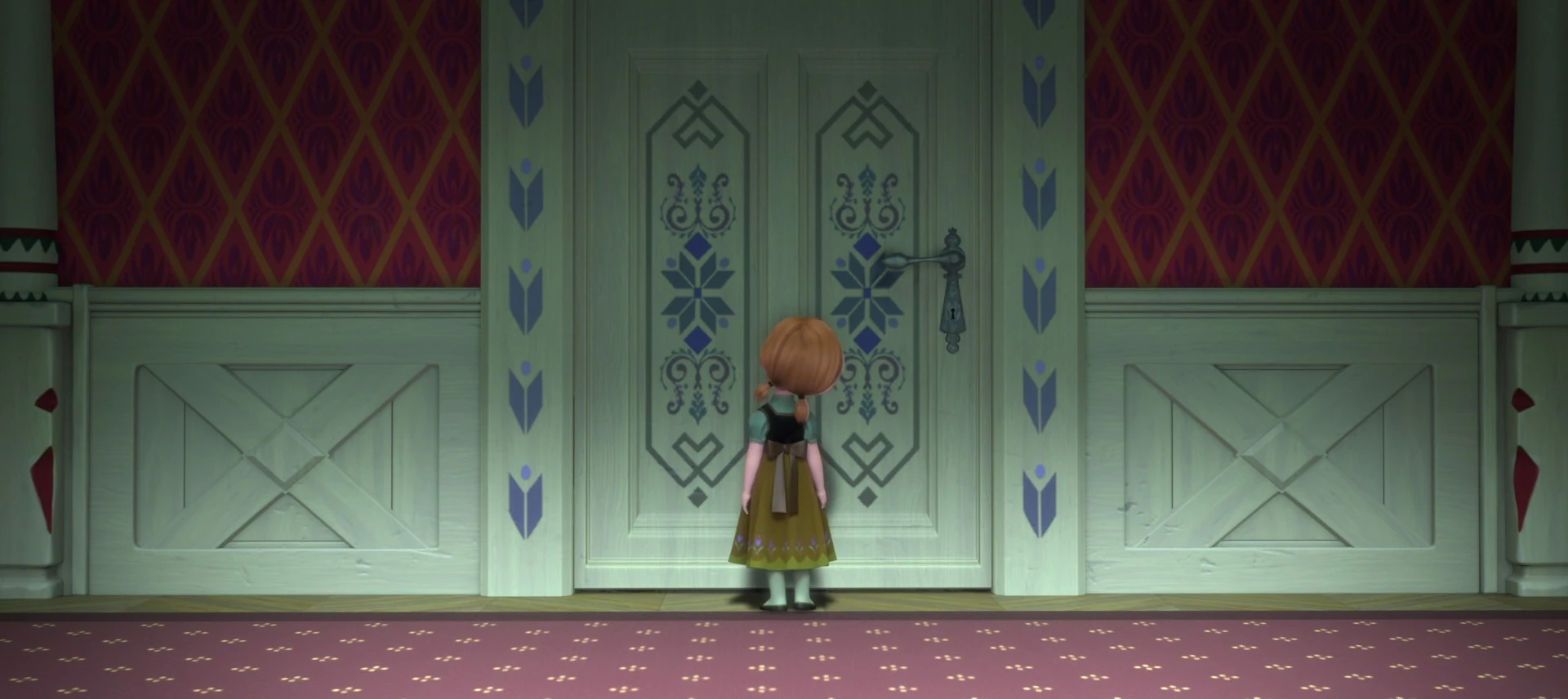
This type of ending reminds the reader of the beginning. Country songs love to do this when it comes to sad songs, and in musicals, this is the refrain's job. I personally would have loved it if Frozen had done a refrain of the "I Want to Build a Snowman" song just after Anna sacrificed herself for Elsa. It would have added some nostalgia for their childhood, thus saying she wishes she could undo all those years. Someone put one together on YouTube and it would have worked beautifully in the movie. But oh well.

The Tieback

This is that moment in a story where you remember the seemingly insignificant tidbit the author threw in back in Chapter 4, and suddenly that tidbit is the key to the solution to whatever problem is plaguing the main character. For example, in Harry Potter where you realize that all along, the fact that Harry's eyes looking like his mother's actually means something.

This happens pretty often, especially in mysteries. The key to writing this sort of ending is having the key thrown in nonchalantly enough that your reader doesn't think much of it, but it needs to be memorable enough for them to remember it and get excited when things click for your main character.

The Time Frame

This is when a story ends because the time is up. This type of ending is classically used in coming-of-age stories, using a school year to shape the beginning and end of the book. Another example would be "Tuck Everlasting," which ends when the summer does (unless you count the jump to the future, when the family sees the grave, but that's more of an epilogue).

Since that particular competition, trial or school year had a definite conclusion in sight, that helps to give a time element throughout, increasing tension. Your characters are constantly facing the end. A Time Frame also provides easy closure. Hopefully you've thrown in other plot lines that are ending in other ways, all around that same time.

Not one of my favorites,
but definitely interesting.
The Space Frame

This is like the Time Frame, but instead of finishing something in time, it's when the characters reach the destination. Examples would include "Land Before Time," Life of Pi, and The Odyssey, though that last one does go on a bit longer. Still, his reaching the destination signals the end of his journey.

The Payoff

This is a satisfying ending--a reward, the revelation of a secret, or the solution to a mystery. Sherlock Holmes stories are completely built around this sort of ending. One doesn't read them to find out whether or not he can crack the case; one reads Sherlock Holmes to figure out how, and his debriefing at the end is the payoff.

Surprise and delight your reader if you are going for this type of ending. It's not as good of a read if it's not what you want or you could see it from chapters away, obviously.

The Epilogue

The purpose of an epilogue is to satisfy reader curiosity or set things up for the next book. I'm sure you're totally familiar with what these are, so I'm going to just move on.

Problem and Solution
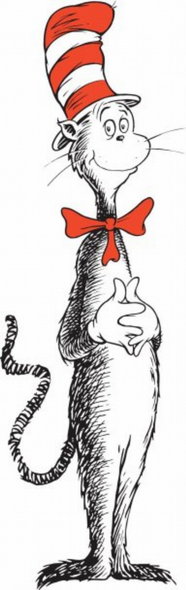
After all, cats
are clean creatures.

This is self-explanatory. The character was faced with a problem -- How am I ever going to get this house clean before Mom comes home?! -- and the solution signals the end of the book -- Oh, look, a cat did all the cleaning just in time.

Most stories end this way in some form or another, since a conflict is built around a problem and it is resolved with a solution.

The Apt Quote

Essays, speeches and blog posts will end this way relatively often. As for stories, perhaps this translates into finishing off the story with dialogue:
"An' they chased him 'n' never could catch him 'cause they didn't know what he looked like, an' Atticus, when they finally saw him, why he hadn't done any o those things ... Atticus, he was real nice. ..."
"Most people are, Scout, when you finally see them."
He turned out the light and went into Jem's room. He would be there all night, and he would be there when Jem waked up in the morning. (To Kill a Mockingbird, by Harper Lee, final lines)
This is what people use when they want to end with people thinking profound thoughts. I'm sure it can be used, and is used, to also finish with a laugh.

Look to the Future

This is when the author gives a hint of what may happen or when the author points toward the logical consequence of what just happened. It's like when a chick flick ends with a kiss. And almost every chick flick ends with a kiss. Whether you take that to mean they started dating or they got married is your own business.

Mobilize the Reader

This is a call to action, often seen, again, in essays, speeches or opinion articles (Op-eds). Can you do it in a story, too? Yes, especially a nonfiction one. Fiction doesn't tend to have a transparent agenda that makes a call to action an option. However, I did read one fiction book, The Poisonwood Bible, which tried this type of ending.

I hated it (and wrote a post to that effect). The book was great until she threw in her call to action.

The end of my Writing Tools posts. There's a whole lot more in the book, so if you felt like my notes were doing you good, maybe you should pick up a copy. (Name that type of ending!)

Saturday, January 30, 2016

More "Writing Tools" Notes - Patterns

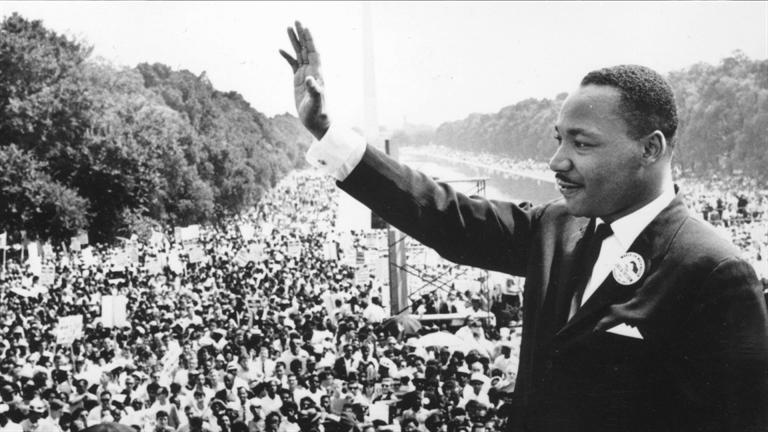
If I was really cool and planned ahead more, I would have posted this closer to Martin Luther King Day. Oh well.

In Writing Tools, Roy Peter Clark advises writers to build, then break, patterns. He says it adds emphasis to the final element, while linking the whole together. Dr. King gives us a prime example:
From the prodigious hilltops of New Hampshire, let freedom ring. From the mighty mountains of New York, let freedom ring. From the mighty Alleghenies of Pennsylvania! Let freedom ring from the snow capped Rockies of Colorado! Let freedom ring from the curvaceous slopes of California! But not only there; let freedom ring from the Stone Mountain of Georgia! Let freedom ring from Lookout Mountain in Tennessee! Let freedom ring from every hill and molehill in Mississippi. From every mountainside, let freedom ring.
He has a sort of stumbling waltz going on: "Let freedom ring" ends the first two sentences, so you're expecting the third, the trifecta, but no--he gives us half a sentence instead and lets us fill in the blank. Then "let freedom ring" is placed at the start of the sentences, and again, not a third. Another broken trifecta, and in this one he places a clause first, then puts "let freedom ring" in the middle of a sentence. Next two sentences, freedom rings at the start. Then he reprises the first sentence structure to end it with "let freedom ring" at the end of the sentence.

Geez, Dr. King. Way to throw patterns for a loop.

We expect a third to complement two matching elements, because that is the custom. If the third is switched, then, it grabs our attention. For Dr. King, this means he kept his audience's attention throughout the whole. How boring would it have been to have the same sentence structure over and over, yet how less full and triumphant if he had only listed three places total.

Clark says that when it comes to lists:
Use one for power; two for comparison and contrast; three for completeness, wholeness, roundness; and four or more for a list, inventory, compilation and expansion.
One last thing I'll add: The repetition of "let freedom ring" is what keeps the whole thing from shattering to pieces. There is still one common element, even though he is continually switching it up and laying faux patterns left and right.

Clark said repetition of words is good for one other thing besides pounding the word into the audience's brain:
(Hemingway) often repeats key words on a page—table, rock, fish, river, sea—because to find a synonym strains the writer's eyes and the reader's ears.
This is not permission to use the same word in every sentence, but it is permission to not think too hard for a synonym when a simple word will continue to do the work. Here's the thing with simple words: they are less memorable. When you are writing, you want your reader to forget they are reading; if you start doing a thesaurus song and dance, you'll pull them out.

For example: I have used the word "three" or versions of it, seven times in this post. I've said "sentence" ten times, seven times in the paragraph underneath all that ringing freedom alone. I bet you didn't even notice.

Saturday, January 16, 2016

"Writing Tools" Notes - Verbs


What I wrote down: Active verbs move the action and reveal the actors. Passive verbs emphasize the receiver, the victim. The verb "to be" links word and ideas.

As a reminder, active verbs are when the subject is doing the verb. Examples: John threw the ball. The ball hit Alice. Alice knows where John lives.

Passive verbs, on the other hand, give the object of the sentence precedence: The snowball was placed in John's pillowcase by Alice. The pillow was soaked by the snowball.

As for the last part of my note, Clark explained, "A verb that is neither active nor passive is a linking verb, a form of the verb to be." (His italics, not mine.) He says that all verbs are either active, passive, or "to be."

Generally, people discourage passive voice for its wordiness and mellow tone. Writing Tools author Roy Peter Clark doesn't discourage passive voice, though; he says to use it for a purpose. What do you want to emphasize? Usually, it will be the subject, but if it is the receiver, then go for it. Use passive voice.

Read this example Clark used and see if you can pick out the passive and active:
Presently I saw a man leaning on a two-strand barbed-wire fence, the wires fixed not to posts but to crooked tree limbs stuck in the ground. The man wore a dark hat, and jeans and long jacket washed palest blue with lighter places at knees and elbows. His pale eyes were frosted with sun glare and his lips scaly as snakeskin. A .22 rifle leaned against the fence beside him and on the ground lay a little heap of fur and feathers - rabbits and small birds. I pulled up to speak to him, saw his eyes wash over Rocinante, sweep up the details, and then retire into their sockets. And I found I had nothing to say to him ... so we simply brooded at each other (John Steinbeck, Travels with Charley)
There was only one passive sentence, but it was there: "His pale eyes were frosted with sun glare ..." Imagine if Steinbeck had used the active. That sentence would have said, "Sun glare frosted his pale eyes ..." Do you hear the difference? The first sounds lazy to me.

But that's the point, isn't it? He comes across as a lazy, laid-back character, and all that Steinbeck did to make it that way was to make him lean back, not move much, and suffer through a single passive sentence. Without that one passive sentence, he seems much more hostile, mainly because then the emphasis would be on "glare," not "pale eyes" and "frosted."

Another note from the book, while we're on the subject of verbs: A good adverb (those exist?!) changes the meaning of a verb. It does not increase the intensity of what is there. Use the correct verb if possible, but use an adverb if necessary to convey the correct meaning. Examples of adverbs Clark would excuse: smiled sadly, killing me softly, sweetly faked.

Using adverbs is lazy if they are doing unnecessary work (backward, isn't it?). Remember that great quote by Robin Williams' character in The Dead Poets' Society?
So avoid using the word ‘very,’ because it’s lazy. A man is not very tired, he is exhausted. Don’t use very sad, use morose. Language was invented for one reason, boys - to woo women - and, in that endeavor, laziness will not do. It also won’t do in your essays.
Yes, "very" is an adverb.