Saturday, May 28, 2016

Quote searching

I've decided on a concept for my business cards for a business I am working on creating, called Stories from the Hearth. Through the business, I will be helping people write down their life stories.

With business cards, you want to make them informative, memorable and professional, right? So my idea is to have all my contact information on one side and a quote about life and/or stories on the other.

This post is going to be a list of quotes I'm considering, partially so I can stare at them more and partially so if you have any input, you can give it!

In the end, it's not the years in your life that count. It's the life in your years. -Abraham Lincoln
My life is my message. -Mahatma Gandhi
Life itself is the most wonderful fairy tale. -Hans Christian Andersen
Life itself is the proper binge. -Julia Child
Memories are the key not to the past, but to the future. -Corrie Ten Boom
The worst part of holding the memories is not the pain. It's the loneliness of it. Memories need to be shared. -Lois Lowry, The Giver
It's like everyone tells a story about themselves inside their own head. Always. All the time. That story makes you what you are. We build ourselves out of that story. -Patrick Rothfuss, The Name of the Wind
Stories have to be told or they die, and when they die, we can't remember who we are or why we're here. - Sue Monk Kidd, The Secret Life of Bees
If history were taught in the form of stories, it would never be forgotten. -Rudyard Kipling
I will tell you something about stories. . . . They aren't just entertainment. Don't be fooled. They are all we have ... -Leslie Marmon Silko

Do you have a favorite quote about life or stories? Post it as a comment! I'd love input!

Saturday, May 21, 2016

What's Elizabeth Reading? ...Andreas Eschbach

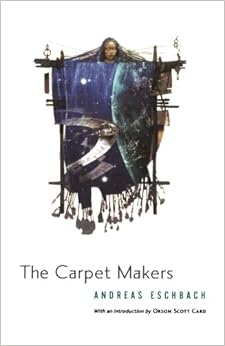
My husband and I took The Carpet Makers by Andreas Eschbach with us on vacation recently. It was both one of the most ridiculous and one of the most atrocious books I have ever read.

The Carpet Makers is a science fiction book that was originally written in German. It has been translated into English by request of American author Orson Scott Card, and frankly, that was the reason I checked it out of the library.

The premise is that for millenia, men have been tying carpets using the hair of their wives and daughters. The creation of one carpet (more of a rug) takes an entire lifetime, and some men die the minute they sell it (an honorable death). Each carpet is sold when completed, and the money from that purchase is given to the carpet maker's son, who then uses that money to live on as he raises his own family (one son allowed, but many daughters encouraged) and creates a hair carpet for the next generation's benefit.

The book is interesting in that it lacks a linear storyline but instead uses short stories, some involving the same characters, to slowly answer the question: What are the hair carpets? Where do they go after they are sold?

The carpet makers believe they go to cover the floor of the deified Emperor's palace. There are rumors, however, that the Emperor (always capitalized) is dead. Of course, that's heresy and impossible, besides. Everyone knows the Emperor is immortal.

The answer to the question of where the hair carpets go is the reason this is one of the most ridiculous books I have ever read. It comes out of left field. I'm pretty sure no one expected this.

As for the atrocity bit, the Emperor is terrible, as were his predecessors, and that's all I'll say about that.

The book is well written, though my husband complained about the lack of a main character or main story thread. I found it intriguing that the story thread was the investigation of a question. We go from a hair carpet maker's home to others in the village, to a merchant who buys a hair carpet, to another who's been buying several, and on from there. I don't think I've ever seen a book that is organized this way.

Warning for those who like happy endings: There are enough atrocities (there really is no better word for it) in this book that it doesn't leave you with a happy feeling at the end. Also, there is no distinct resolution.

One aspect of science fiction is that it is an avenue for critiquing one's society. It says, "Here is a problem in society today; let's make it bigger than it really is and see how things go." For example, 1984 by George Orwell was written in response to the leader worship Orwell was seeing in the world (see this letter for more on that).

The Carpet Makers reflects on tradition and how it can blind people to reality. It could also be considered a reflection on religion as a whole, and it doesn't put it in a positive light.

It makes me wonder whether there are any traditions I follow out of ignorance. I can see how others may be in this situation, but it's harder to see it in myself. Maybe that is part of what Eschbach is saying, and it's a sort of Plato's Cave. I can't see that reality is different from being as I see it because nobody has shown me anything different -- and even if they do tell me I'm wrong, I may not believe them.

Things to think about, which means that even with the atrocities and absurdity, this book is worth a read.

Saturday, May 14, 2016

What's Elizabeth Reading? ...Blake Lingle

The last book I reviewed for my job at the Idaho Press-Tribune: "Fries! An Illustrated Guide to the World's Favorite Food."

Sounds prestigious, no?

Well what if I told you it was written by Blake Lingle, co-owner of the Boise Fry Company, which U.S. News placed at the top of a list of the ten top fry makers in America?

Fries!: An illustrated guide to the world's favorite foodYou can read what I wrote for the newspaper here. It gives a pretty good idea of what sort of book it is (humorous, informational, conversational) and the information it contains (did you know that Thomas Jefferson might have been the person who first brought fries to America?).

I read this book in two sittings. It is an easy read, not a work of great literature, but enlightening just the same. Not every book needs to be a literary marvel, after all.


I will say this for the book: A couple days later, I used Lingle's algorithm for fry making in my own kitchen. I fudged on a bunch of it, because I didn't want the process to take an entire day (literally; pre-fry freezing time is 12-24 hours), but mostly stuck to what he said. The resulting fries tasted like fries.

If you think about how many things people try to copy off restaurants and get wrong, you may realize this is a small miracle. My husband was less impressed; he said my fries tasted just like the ones he grew up making by just slicing up a potato and throwing it straight in the deep fryer.

Either way, my faith has been marginally restored in the fast food industry. I had always figured fries were mostly chemicals and not much potato, but it turns out that even if that is true, the taste is spot-on.

The Boise Fry Company does gourmet fries, from what I gather. The website urges people to pick their potato (Russet? Purple? Yam? Brussels sprout?) and cut (Shoestring? Regular? Curly?). They have many different sauces, and the cuts and types of fry vegetable change daily.

So no, this book does not just cover conventional fries. Nor, sadly, is it a cook book, though there is a recipe here or there. It is an informational book set into easy sections of history, where fries come from, and others, and interrupts itself often with lists, instructions or that algorithm I mentioned earlier, which is a graphic that takes up two pages.

Read it if you want to know more about fries than you have ever thought of asking about. Also read it if you have an interest in contemporary book formatting, because it is not regular in that sense (by that, I refer to all those interruptions. They are full-page interruptions, set apart from the main text).

And keep fries handy while you read, because you'll find yourself craving some sooner or later.

Saturday, May 7, 2016

My column won an award!

I write a column for the Idaho Press-Tribune called the Front Porch. It has a chatty tone and contains the little news you would expect of a hometown newspaper, such as scholarship winners, class reunion notifications, and volunteer requests. It also includes the fun news that has no news value besides being interesting -- for instance, a man brought by some packets of seeds he'd found among his mothers things. They dated back to the 1970s, and he is going to plant them to see if they'll grow. He plans to check back in to give us an update.

I have also covered some small events, of the same sort, like when a local gym had a photo shoot with a few of its female members to show what "real women" look like, the sort who try to stay in shape but also enjoy cookies and milk with their kids now and then.

Even though I'm moving, I'm going to continue writing the Front Porch as a freelancer. The other news having to do with my column is it won an award! Third place at the Idaho Press Club awards for General Column. In the journalism contests I've been privy to, it's a custom that people only get awards if they deserve it. There may be a category with submissions, but if none of the submissions are any good, no one will get an award at all. There were several categories at the awards night with only a first place winner, or a first and second. That said, it actually means something that I got third place and it's pretty cool -- it means that at age 24, I'm an award-winning columnist!

Most of my columns are collections of "tidbits," short summaries, with commentary, about what happened. They are rarely over 300 words each, and a handful make up one column. For the contest, I submitted three columns that were just one massive tidbit. One such column (not one from the contest) is below so you can enjoy it and I can celebrate. It was headlined "Girl shines on 8th grade football team."
(This is the header to my column when it appears in print)
Emalie Wood wanted to play football.
She already played soccer, golf and basketball, but something about football appealed to her enough that even though her father, a soccer coach, tried to dissuade her, she joined the Middleton Middle School eighth grade boys football team at the start of the season.
And unlike the two other girls coach Bob Santi has had in his years coaching football, Emalie stuck with it to the end of the season, becoming a strong asset to the team and leading Bob to call her one of the best athletes — boy or girl — in the school.
She’s played kicker, defensive back, cornerback, defensive end and receiver; she wanted to try out the quarterback position, too, but there just wasn’t time in the season, Bob said.
It’s too bad our newspaper doesn’t cover eighth grade sports, because it would have been fun watching her trademark pink socks and long ponytail (it’s a penalty if you pull it, by the way) pop up in newsprint throughout the season alongside her No. 1 jersey.
I just had to ask Bob why she made it and those other two girls didn’t. He said part of it was because the other girls were talked into it, whereas Emalie had to talk others into letting her do it.
He also talked about his football team and the impressive boys who fill it, saying it is the best group of boys he has ever had the privilege to coach in regards to their grades, athleticism, morals and maturity.
From what he said, these boys respected her and had her back at all times.
In fact, Emalie was just like one of the guys, being smacked on the shoulder pads and helmet whenever she made an impressive play, sitting in the back of the bus and joking with her teammates on trips and greeting them in the hallway whenever they crossed paths during school.
Thanks to that last bit, of course, some of her girl friends asked her to introduce them to members of the team.
Speaking of her girl friends, she had a great group of friends that would support her at her games — even some that were away games — by cheering and waving a sign they had made especially for her.
The home crowd also got behind her; Bob said “she started out as an anomaly … and then she was still out for football, and then she was still out for football, and then people got used to it and kind of just climbed on her bandwagon.”
Her dad, Rorque Wood, recalled her first tackle, saying she was playing defensive end and the opposing team was on the 4-yard line. She tackled the ball carrier and her team got possession of the ball. He said that was her “I’m in the club” moment.
Perhaps that amount of support was another reason for her successful season. The team made it to the playoffs, by the way, and Bob said she was an integral part of that. Actually, in the playoff game itself, they were playing South Middle School and she executed a kickoff near the end of the first half that set the other team to starting on the 6-yard line. They won 14-0.
But maybe Emalie’s successful football season had more to do with herself.
“She’s pretty persistent, and she has a pretty strong will, and she has a good heart,” her coach said. He also praised her good attitude.
As for her father, when I talked with him over the phone, I could just hear his smile the entire time. Rorque recalled the moments in the stands where people would wonder who the girl was on the team, and he would get to say, “That’s my daughter!” He is, for good reason, proud of her.
He also said, and I quote: “Maybe I should have let her play (earlier).”
So what’s next? Will she be playing on the freshman football team? By all reports, she hasn’t quite made up her mind yet, but if you are watching next season and see a pair of pink socks, you’ll know who is wearing them and know to give her a loud cheer.
* Elizabeth’s Note: I didn’t get to interview Emalie for this, mainly because it was a surprise for her from her dad. Sorry about that, but I think it was a good reason. Surprise, Emalie! Good luck with basketball!

Saturday, April 30, 2016

What's Elizabeth Reading? ...Harper Lee

I read "To Kill a Mockingbird" in high school, but didn't remember most of it. When Harper Lee passed away, I figured it was time to revisit the book in memoriam of her.

Interesting, by the way, for an author whose book prominently featured a social recluse to be a social recluse herself.

The main thing I found myself focusing on while reading this book, like when I read Anna Karenina, was what the book is about. When you hear about "To Kill a Mockingbird," the primary discussion is about race, with particular attention paid to Tom Robinson's trial. For those who have not read it: The book is set in Alabama in the 1930s, and Tom Robinson is a crippled black man who was accused of raping a white woman. It goes to court and Atticus Finch becomes one of the most famous lawyers in literary history by defending him and asserting the charges are a lie.

Seriously--I just Googled "most famous literary lawyers," and the first result was titled "The 25 Greatest Fictional Lawyers (Who Are Not Atticus Finch)."

That being said, I kept expecting the trial to come up sooner. The first time I see it being alluded to is on page 74 (out of 281), and the entire episode comes to an end on page 241. That's 114 pages without Tom Robinson's case in it, and that's two-fifths of the book. How can that be the focus of the plot as a whole?

Instead, Arthur "Boo" Radley caught my eye. His pages are fewer, but are bunched up mostly at the beginning and end of the book. Boo is prevalent on pages 3-72 and again on pages 263-279, a total of 85 pages, half what Tom Robinson got. So why did he stick out? He got prime real estate: the beginning and end.

Boo is the social recluse I mentioned earlier; a man who no one ever sees, though they know he's still alive because they haven't seen his corpse being taken away. He is an object of fascination for the children, Scout, Jem, and Dill.

There are also portions of the book dedicated to an old woman with a morphine addiction who is grumpy and mean as can be, Hitler, the education system, a mad dog, poor white people, the supposed importance of having an old family and sketches of many other people in town.

The running thread I found, framed by Boo, is prejudice and hypocrisy. It is not just racism; it's bigger than that.

Toward the end of the book, Scout, the narrator, begins questioning why people treat each other the way they do. Hitler is the biggest example; she wonders why people look down on black people yet despise Hitler for looking down on the Jews.

In short, this seems to be a book people are striving to live by today. Its philosophy of being polite and honest to everybody, no matter what, is the epitome of contemporary virtue.

Saturday, April 23, 2016

Analysis exercise, Alice Munro

Retyping, an exercise in noticing how a writer writes. Today, I'll retype a passage from Nobel Prize winner Alice Munro's "Free Radicals," which was published in "The New Yorker" in February 2008, then analyze it.

This was the cover of the edition it was in.
I love "The New Yorker."
At first, people kept phoning, to make sure that Nita was not too depressed, not too lonely, not eating too little or drinking too much. (She had been such a diligent wine drinker that many forgot that she was now forbidden to drink at all.) She held them off, without sounding nobly grief-stricken or unnaturally cheerful or absent-minded or confused. She said that she didn't need groceries; she was working through what she had on hand. She had enough of her prescription pills and enough stamps for her thank-you notes.

Her closer friends probably suspected the truth--that she was not bothering to eat much and that she threw out any sympathy note she happened to get. She had not even informed the people who lived at a distance, to elicit such notes. Not Rich's ex-wife in Arizona or his semi-estranged brother in Nova Scotia, though those two might have understood, perhaps better than the people near at hand, why she had proceeded with the non-funeral as she had done.

Rich had told her that he was going to the village, to the hardware store. It was around ten o'clock in the morning, and he had just started to paint the railing of the deck. That is, he'd been scraping it to prepare for the painting, and the old scraper had come apart in his hand.

She hadn't had time to wonder about his being late. He'd died bent over the sidewalk sign that stood in front of the hardware store offering a discount on lawnmowers. He hadn't even managed to get into the store. He'd been eighty-one years old and in fine health, aside from some deafness in his right ear. His doctors had checked him over only the week before. Nita was to learn that the recent checkup, the clean bill of health, cropped up in a surprising number of the sudden-death stories that she was now presented with. "You'd almost think that such visits ought to be avoided," she'd said.

If you want to read the full thing, you can, for free, here.

Here is what I noticed. First were the lists in that first paragraph. I could just imagine those phone calls, with people on the phone not knowing what to say. How are you? She gives a short answer. I'd understand if you're depressed, they say. No, I'm fine, thank you, she replies. Would you like some company? I'm sure you're lonely. No, I'm fine, thank you. Et cetera. Awkward conversations on both sides, the sort of conversation that ends in a sigh of relief for them, that they did their duty of reaching out to her, and a sigh of relief for her that they've finally hung up to leave her alone. The use of a list also makes it feel like everyone asks the same set of questions, and she could almost check them off on her fingers as the conversation goes on.

I also noticed the repetition of "too." They obviously expect her to be depressed, lonely, etc., but just want to make sure it isn't serious. Is she fine enough that they don't have to do anything to help? It is as if they are essentially checking to make sure she doesn't commit suicide.

This image went with the story online.
It's attributed to Sam Weber.
Also, the use of the "At first" that the story starts with--it shows that people were interested right after the death, but soon turned their attention to other things (a problem I think we all have, sadly). The phone calls stopped or changed in content before too (haha) long.

As for the "drinking too much" bit, it illustrated, before Munro spelled it out, that these people barely paid attention to her before the death. They didn't know her or care enough to remember that she doesn't drink at all. I'm sure the switch from drinking often to not at all was a life event for her and those people who were truly in her life would have known about it and remembered.

The second list is her list: Don't sound grief-stricken. Don't sound unnaturally cheerful. Don't sound absent-minded or confused. She must be a self-conscious woman who cares about the impression she gives to others. Or she doesn't want to do anything to make them concerned and stay on the line (which is more likely).

Oh, and the "held them off" is a nice touch.

After a public view in the first paragraph, we zoom in to see her actual friends. We get a view of what is actually happening, and we learn her husband's name. I had assumed from the first paragraph that her husband had died, mainly because she was apparently living alone, she was old, and something tragic had happened to her. This is the paragraph where we definitively learn there was a "non-funeral." That comes right after learning she didn't tell the non-family members (telling us she and her husband didn't have much by way of true family, but had lived alone). If they had had true family members, they would have been mentioned in this paragraph.

By the third and fourth paragraphs, we zoom in enough to see what had actually happened. Note the details used, things that symbolically mean little but add reality to the event: He was scraping old paint off the deck when he went to the hardware store and died by a sign out front that was trying to sell lawnmowers. This is not a death she has romanticized at all (a common trait in contemporary fiction).

This may seem like a small detail, but she wrote out "ten o'clock in the morning." There are so many ways to show the time, from the newspaper's "10 a.m." to "10:00 a.m." or "ten in the morning." Contemporarily, people will even just write "10." But no, it's written out here. I'm not sure if that is because of "The New Yorker's" style, but even if it is, writing it out longhand points to her age and temperament. She isn't so anal or grief-stricken as to know the exact minute, or even to know if it was 10:30. She writes out "in the morning," which is not the utilitarian "a.m." and is reminiscent of an older style. People rarely even say "o'clock" anymore, have you noticed?

In a nod to possible symbolism, the old scraper had "come apart in his hand." Practically, it could mean he was having a hard time with the scraping because he's in his 80s. It could also be that the scraper was just old and gave out--like he did.

In that final paragraph I gave you, I love the detail that now everyone is telling her sudden-death stories. This is exactly what happened to me when I last visited my grandma's cousin, who lives near me. I visited to tell her that her brother had died, and at some point in that visit she started telling me stories about how people in our family have a history of simply dropping dead. It was mildly concerning.

I'm sure that people were telling Nita stories about other deaths because they were trying to show they understood. I've noticed that when someone says x happened to them, the people around them start chirping in about how they've had the same experience, except this was how it was different. It must have something to do with a sense of community.

Last comment on the story: "You'd almost think that such visits ought to avoided," Nita says. "Visits" could mean either visits to the doctor or visits to people in mourning. Munro did a nice job of using one word to say two things at once.

I share this analysis for two reasons. 1) It was a good exercise for my reading skills. 2) If you read enough analyses like this, you should be able to do the same thing, and that should improve your writing. Try doing analyses yourself sometime. You'll read more out of what you read.

Saturday, April 16, 2016

Dictating - what a concept

If I were an English teacher, I would allow people to turn in audio essays.

Now, I understand that English teachers are supposed to teach proper punctuation and spelling, but everything else they are teaching by assigning written essays -- grammar, sentence fluency, argument structure, different poetic tools, etc. -- can just as easily be worked on in a verbal form as in a written one.

It may make it tricky to grade or to give feedback on, so here's how it would go: Students would record an audio essay, then follow-up with an assignment to write it out and critique it.

My reasoning is that there are many people who have trouble writing. They have thoughts they can voice aloud, but confronted with a page, everything goes haywire. The dictation method bypasses this issue and allows a person to simply voice their thoughts aloud.
wooden dictator
I searched "dictation" on Freepik.com and got this.
No idea why.

Typing it out forces a person to look at how they sound (an excellent tool if you're trying to become a better speaker). Past the umms and pauses, they should receive a confidence boost in their ability to write an essay. They just dictated one, after all, and that's no different from writing.

Maybe, just maybe, this would allow someone to learn how to write. They could then learn to speak with their hands instead of their mouths, because that's all writing is. Perhaps it would help them get past the page barrier.

All of this said, it's time to give a life update. I'm leaving my job at the Idaho Press-Tribune in a few weeks. I'm moving to Utah, then starting a business helping seniors write their memoirs through dictation. The memoirs will be collected into a book and printed for their family members.

So I'm not an English teacher, but I'm going to try my hand at turning this audio essay idea into a business. Wish me luck -- I'm sure you'll be hearing about it.