Saturday, June 25, 2016

What's Elizabeth Reading? ...Alan Alda

I've entered a new phase in my reading: I'm reading autobiographies.

I don't think younger me would be impressed. Actually, that depends on which age of younger me you're asking. Some of those ages might have been in awe of my sheer adultness. Because boring adults read autobiographies, right?
I'm not so sure about that anymore.

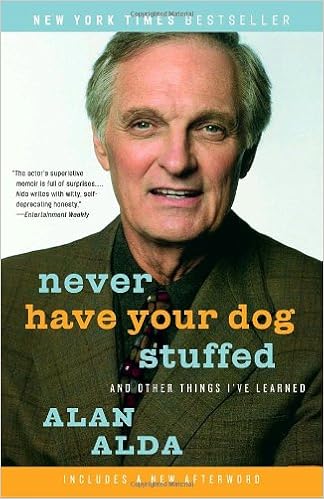
I am reading autobiographies as research for Stories from the Hearth, the personal histories company I am starting, because I figured I should be more familiar with the genre of real stories, and I chose to start with Alan Alda's Never Have Your Dog Stuffed for three reasons:

1) The length was reasonable for the overworked person I am becoming (272 pages in paperback).
2) I wanted to know why I shouldn't have my dog stuffed, should I ever get one.
3) It's Alan Alda. M*A*S*H was an amazing TV show.

The first thing to be noticed about this book is that it is broken down into three sections, or "acts," that follow the structure laid out in the book's epigraph (quote that kicks it off): "Act one: Get your hero up a tree. Act two: Throw rocks at him. Act three: Get him down again." (Attributed to George Abbott)

So the first section is about how Alan Alda got involved in acting (in short, his father), the second is about how hard he worked to be successful (this included working as a clown on street corners, among other interesting stories), and the third is about success and his later life.

Beneath that overarching structure, stories are mostly given according to chronology. He does jump back and forth a bit, to serve his main topics and sense of drama, I think, and it's a little disorienting. The main topics he sticks to in the autobiography are his parents -- unstable mother, famous actor father -- and his acting. He bounces between these topics, trying to give his life a traditional story arc. I'm not sure I'm a fan of that, but since this book seemed to have, at its heart, the object of entertaining, I'll give it a pass.

I could tell Alda was out to entertain from the moment I read the first sentence: "My mother didn't try to stab my father until I was six, but she must have shown signs of oddness before that."

I mean, what person starts out an autobiography that way? Not David Copperfield, for sure. Usually people follow the king of Wonderland's advice and start at the beginning. This was not the beginning; it was a hook.

Not necessarily a bad thing, just different.

Alan Alda
My main problem with it being an entertainment autobiography is that I came away feeling like I did not know Alda well. I know almost nothing about his marriage or his children, for instance. I know their names, and I know how he met his wife (it included him going AWOL from the military multiple times in efforts to visit her a couple states over, amusingly enough). There are moments here and there when they show up, but this is mainly about Alda. Somehow, the man wrote an autobiography while keeping his privacy intact.

Useful for a famous actor, but not really what my clients will be going for.

HOWEVER. This book would be, I think, useful to someone pursuing a career in acting. Besides the pick-me-up of, "Wow, he had to work really hard to get where he did, even with all that talent," there are nuggets of wisdom sprinkled throughout the book that would serve an actor well. For instance, he talks about how he learned to cry real tears on command. He also discusses empathy at some length.

For those who are interested, some fun facts about Alan Alda:

  • Alan Alda is not the name he was born with. That was Alphonso D'Abruzzo. He actually hated the name "Alan Alda" when it was first proposed.
  • He was beat up in school for trying to entertain the "crowd" during recess.
  • Spent some time doing a film in a prison in Salt Lake City, UT (cool for me because it's near my hometown)
  • He wasn't sure he was going to be able to pull off being Hawkeye Pierce until the first moment the camera was actually rolling.
  • He grew up in the world of burlesque, and so was surrounded by comedians and exotic dancers.
  • He once had polio.
  • He had his dog stuffed.
It seemed like every day, I was turning to the people next to me and saying, "Did you know, Alan Alda ..." I'm sure it would have gotten on their nerves more if the man didn't have such interesting stories to tell.

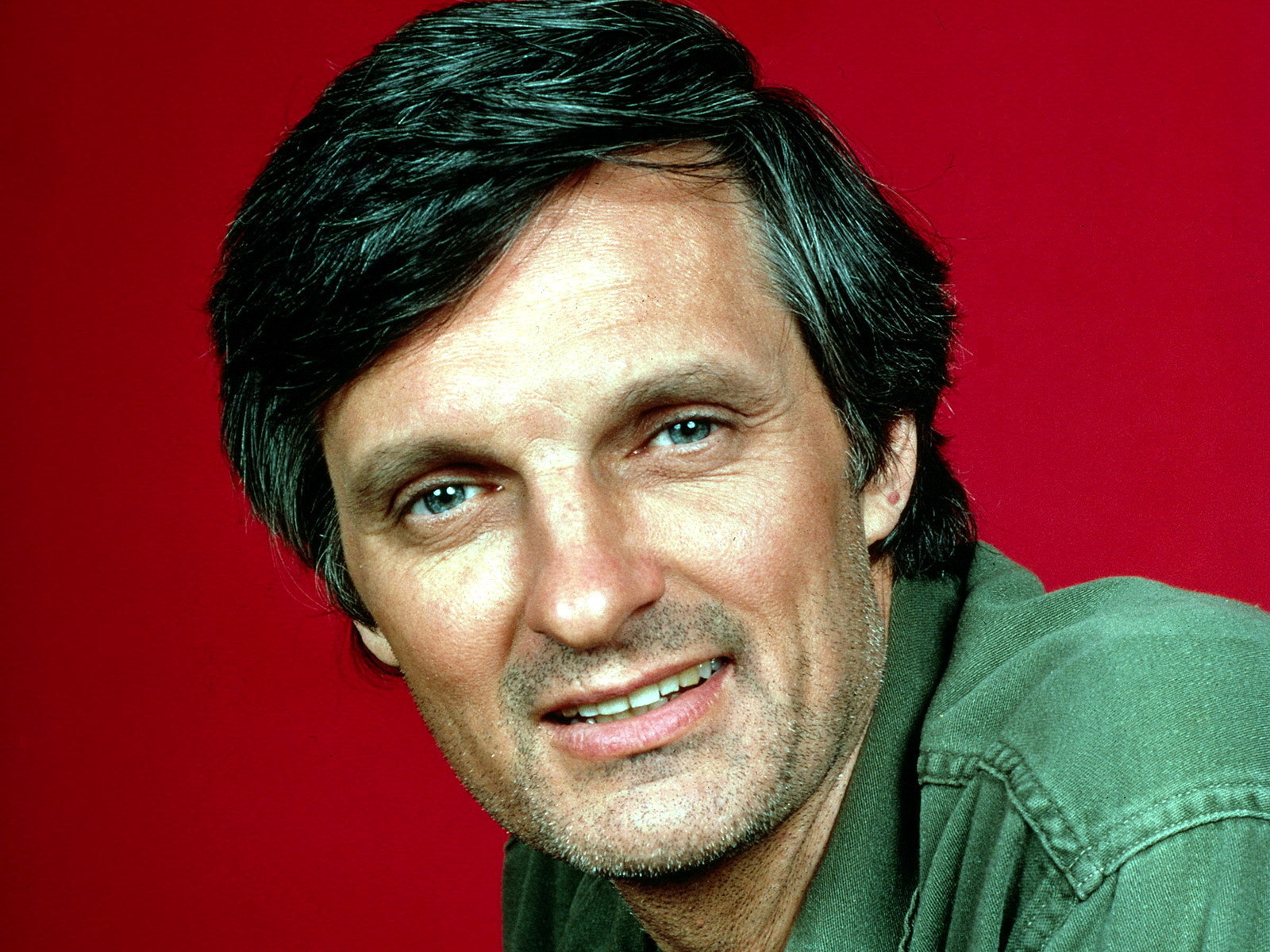
Captain Benjamin Franklin "Hawkeye" Pierce
Yes, he does dedicate some time in the book to M*A*S*H, as well as some time to Scientific American Frontiers, which I found out ran for even longer than M*A*S*H (14 years. He was Hawkeye for 11). It kind of feels like he includes these sections as crowd pleasers, the "We all know why you picked up this book today," chapters, but he's right. I wanted to hear about them. Nothing wrong with knowing your audience.

After finishing the book, I went to the library and borrowed the first and last season of M*A*S*H, just to see how I would feel about it now.

But you know what? I didn't see Alan Alda acting. I saw Hawkeye.

So no, this is not the autobiography of the man who played Hawkeye, because Hawkeye was so real he wasn't really played by anyone. This is the autobiography of the man who became Hawkeye.

Saturday, June 18, 2016

Why keep taking language arts classes once you're literate?

My brother found a summer job with the company I am working for, and we live in the same city, so we carpool to and from work each day. It's been great for sibling bonding time -- we've talked TV shows, meditation, politics, you name it. On one day this week, the topic became language arts classes. His question: Why does the school system ask students to continue in language arts after they already know how to read and write?

I thought it was worth discussing here, too, so here are my thoughts.

My brother. Except he isn't Leo, obviously.
In elementary school, people are taught the basics of how to read and form letters. By the fifth grade, I was being taught how to write essays. In middle school, classes read books together and learn more about literary devices such as similes, alliteration and rhyming. I was also introduced to reading and writing poetry in middle school. By high school, students are focusing on essay writing and book analyzation (I wrote another post about analyzing books a while back. Read it here). We are told that writing essays teaches us how to form arguments. It is also an avenue for teachers to help improve writing skills -- grammar, sentence fluency, that sort of thing.

Along the way, teachers select books for their students to read. Sometimes, these books are part of a bigger, government-dictated curriculum. Other times, teachers choose books they think will interest their students or help them through a particular stage in life. This is why so many middle schoolers find themselves reading coming of age books like Bridge to Terabithia or The Outsiders. Some teachers will also select books they loved themselves and want to share with the students, since the books are age appropriate (if your child's teacher has them reading Harry Potter, this is what happened). The other three factors I can think of that would affect book selection would be current or recent events, genre introduction and cultural aptitude (this is the main reason for all the Shakespeare, I'm sure of it).

Teachers guide youths' reading up until they are set free by the school system and either re-enter by going to college or go off on their merry way into the work force. Recreational reading outside of the assigned books is encouraged, of course, but you have to admit that teachers do a lot of book introducing for youth.

As for college, those language arts classes teach specific aspects of the language or writing in it. After all, even though you know how to read and write, you can still improve. This is why we continue taking language arts classes.

Note: Philosophy can be taught using
literature and film, too.
However, language arts classes should also teach more forms of writing than essays. Philosophy classes (in high school) can take over on the essay front, since one major purpose of the discipline is argument formation and presentation. A philosophy class, or at least a language arts class with a strong philosophy component, would produce deeper thinkers and people who can express themselves well.

As for what else people would be writing in those language arts classes, the only times in real life when essays are used are in the justice system, book introductions and academics, so far as I can tell. Adults write in other formats: blog posts, articles, press releases, business correspondence, letters (cover letters, query letters, others), creative writing, memoirs, reports (which aren't written in MLA format!), speeches, contracts, and more things I can't think of right now. Imagine how much better these communications would be if we had classes in how to write them well!

The main problem with this is we don't have teachers trained to teach all these various forms of writing.

But alas, I am not a teacher and would be scolded for telling other people how to do their jobs. So I'll step off my soapbox with one last sentence: Brother, language arts classes should continue, but with a stronger philosophy component and varied writing instruction.

Saturday, June 4, 2016

Doubting my story beginning

The following is the beginning of the first chapter of the novel I have been working on for some time now (think years; I'm a slow writer).
Elke had never liked porridge, but his dislike for the bland mush that filled his wooden bowl this morning was dwarfed by his dislike for the look on his mother’s face. He had seen it way too many times this past week, and he knew his best bet was to quietly force himself to swallow his breakfast and disappear for a few hours—but not so far that he couldn’t hear her call his name.
He averted his eyes from hers, sure that her uncanny ability to read them would only spell more trouble for him, and then he wouldn’t be allowed to disappear but instead would be stuck chopping wood, even though winter was a long ways off. He stared at a knot in the table instead and did his best to eat quietly.
Mother was sitting in a chair near the open front door, hand over her eyes and head tilted back against the frame. She usually would have been sitting across from Elke, swatting at his hand if he held the spoon incorrectly, but the head pains always rendered her more quiet and still, and she craved the fresh air without the sounds of Nostos. She looked up now and then to see if he was eating, but that was all.
When he was finished, he did his best to quietly stand up. He winced when his chair squeaked and mother flinched, then carefully rinsed out the bowl using the bucket of water mother kept for that purpose. He kissed her cheek on his way out the door, whispered that he would be back to check on her, then crept away from the house, breaking into a run once he was out of earshot.
“Arato! Get up, you slug! Can’t let Sakuunu see you in bed at this hour!” He slapped on the wood wall of his friend’s home, aiming for the spot where his bed met the wall. Elke paused to listen, then slapped the wooden planks a couple more times for good measure, moving to the front door when he was sure he heard Arato get up.
He bounced a little in his deer-hide shoes while he waited, then opened the door to peek inside just as Arato came scrambling out. “Welcome to the morning, brother!”
“Oh, go eat a pine cone,” Arato said, still adjusting his apprentice necklace, a leather strap ornamented with a metal hoop similar to those that held barrels together.
“I’d rather not be seen eating the ancestors, thanks,” Elke said. He instinctively checked to make sure he hadn’t forgotten to wear his own apprentice necklace with its accompanying miniature cloth stachel, meant to represent the full-sized ones carrying seed. He, however, was carrying a couple coins in his -- something his mother would kill him for if she were to find out.
“So do it at night, when the sane people of this world are asleep.”
“I sleep!”
They had been walking, but at this, Arato stopped and turned toward him, an incredulous look on his face.
“Most of the time,” Elke said, grabbing his friend’s arm to get him going again. “We’re going to miss it. Come on.”
They had just managed to climb into one of the trees when the first girl walked through the meadow. This one was Pylliah, who was too young to have a woman’s figure but too old to bathe with the children. She had carefully wrapped herself in her towel but was walking with a slight cower just the same, hiding herself from the world at large until she could put on her proper clothing. Elke and Arato didn’t waste more than a glance in her direction, instead fixing their gaze on the path to the river, waiting for the next female to emerge.
It turned out Arato’s early wakeup had paid off, because Sakuunu was in the small group of women who followed Pylliah out from the bathing place. Elke had little interest in her, though he could appreciate how her long black hair waved slightly as she walked and the way her towel hung from her figure to reveal its perfection. He knew her to be a tad self-centered and she had mocked him one too many times to earn his desire. Arato was another story; he had been smitten since the day he had first seen her ride one of the village’s horses through the street. Arato had walked into Elke’s home with a glazed look on his face and had stayed that way until Elke had thrown a handful of fish guts at him.
Sakuunu was one of the few to wear her apprentice necklace, ornamented with a miniature horse, to the bathing place. Some of the women were too old to have them and instead wore the armband of their trade, and others, like Pylliah, were as yet too young. Elke and Arato had only received theirs the month before, and Elke was still having a hard time remembering to wear it some days.
Arato scooted forward on the branch he was lying down on, legs holding it tightly beneath him and arms propping his shoulders and head up slightly. The movement caused the tree to shake a little, but it seemed none of the women noticed. There were four of them in Sakuunu’s group, one of whom was her mother. All were wrapped in their towels, feet clad in wooden bathing shoes. They were laughing about something.
Arato scooted forward again, bringing himself to the edge of the leaves, where even one more inch would expose their hiding place. Elke was tempted to either push him off or haul him back in, but indecision about which would be better kept him from doing anything. Besides, there were more women bathing and one may bring him to the edge of his branch, too. He didn’t have his eye on anyone, but he knew that could change any day.
Sakuunu paused before leaving the clearing, gesturing her companions onward and turning back.So she had noticed, then. This ended Elke’s moment of indecision and he leaned forward, shoving Arato to the side. His friend had been too entranced to hold on properly, and the shove sent him crashing to the ground at Sakuunu’s feet.
I like this beginning, because I think it is fun and well-written. It introduces some of my main characters in a personable way and gives each a foundation to stand on. My problem with my beginning (it is longer than this) is that it doesn't really take the story anywhere.

So this week, I had the thought to open it in a very dramatic way: a self-defense killing. I wrote it the next day, about 380 words, and am not as impressed with it as with my original beginning. Perhaps I stick my self-defense killing elsewhere in the story?

Truth be told, my main problem is I want to get the story moving but don't feel like a good enough writer to do it justice. I have a basic outline for it in my head and love it, but I feel like except for a few bright spots, like this scene, it's not all that great yet.

Maybe this post is a pep talk, a reminder that I can write well and all writers start somewhere. I defer to Ira Glass to make the motivational point:
“Nobody tells this to people who are beginners, I wish someone told me. All of us who do creative work, we get into it because we have good taste. But there is this gap. For the first couple years you make stuff, it’s just not that good. It’s trying to be good, it has potential, but it’s not. But your taste, the thing that got you into the game, is still killer. And your taste is why your work disappoints you. A lot of people never get past this phase, they quit. Most people I know who do interesting, creative work went through years of this. We know our work doesn’t have this special thing that we want it to have. We all go through this. And if you are just starting out or you are still in this phase, you gotta know it's normal and the most important thing you can do is do a lot of work. Put yourself on a deadline so that every week you will finish one story. It is only by going through a volume of work that you will close that gap, and your work will be as good as your ambitions. And I took longer to figure out how to do this than anyone I’ve ever met. It’s gonna take awhile. It’s normal to take awhile. You’ve just gotta fight your way through.”

Saturday, May 28, 2016

Quote searching

I've decided on a concept for my business cards for a business I am working on creating, called Stories from the Hearth. Through the business, I will be helping people write down their life stories.

With business cards, you want to make them informative, memorable and professional, right? So my idea is to have all my contact information on one side and a quote about life and/or stories on the other.

This post is going to be a list of quotes I'm considering, partially so I can stare at them more and partially so if you have any input, you can give it!

In the end, it's not the years in your life that count. It's the life in your years. -Abraham Lincoln
My life is my message. -Mahatma Gandhi
Life itself is the most wonderful fairy tale. -Hans Christian Andersen
Life itself is the proper binge. -Julia Child
Memories are the key not to the past, but to the future. -Corrie Ten Boom
The worst part of holding the memories is not the pain. It's the loneliness of it. Memories need to be shared. -Lois Lowry, The Giver
It's like everyone tells a story about themselves inside their own head. Always. All the time. That story makes you what you are. We build ourselves out of that story. -Patrick Rothfuss, The Name of the Wind
Stories have to be told or they die, and when they die, we can't remember who we are or why we're here. - Sue Monk Kidd, The Secret Life of Bees
If history were taught in the form of stories, it would never be forgotten. -Rudyard Kipling
I will tell you something about stories. . . . They aren't just entertainment. Don't be fooled. They are all we have ... -Leslie Marmon Silko

Do you have a favorite quote about life or stories? Post it as a comment! I'd love input!

Saturday, May 21, 2016

What's Elizabeth Reading? ...Andreas Eschbach

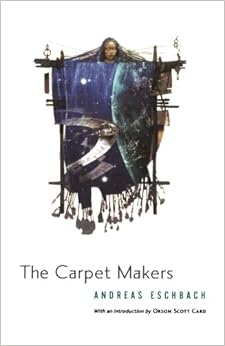
My husband and I took The Carpet Makers by Andreas Eschbach with us on vacation recently. It was both one of the most ridiculous and one of the most atrocious books I have ever read.

The Carpet Makers is a science fiction book that was originally written in German. It has been translated into English by request of American author Orson Scott Card, and frankly, that was the reason I checked it out of the library.

The premise is that for millenia, men have been tying carpets using the hair of their wives and daughters. The creation of one carpet (more of a rug) takes an entire lifetime, and some men die the minute they sell it (an honorable death). Each carpet is sold when completed, and the money from that purchase is given to the carpet maker's son, who then uses that money to live on as he raises his own family (one son allowed, but many daughters encouraged) and creates a hair carpet for the next generation's benefit.

The book is interesting in that it lacks a linear storyline but instead uses short stories, some involving the same characters, to slowly answer the question: What are the hair carpets? Where do they go after they are sold?

The carpet makers believe they go to cover the floor of the deified Emperor's palace. There are rumors, however, that the Emperor (always capitalized) is dead. Of course, that's heresy and impossible, besides. Everyone knows the Emperor is immortal.

The answer to the question of where the hair carpets go is the reason this is one of the most ridiculous books I have ever read. It comes out of left field. I'm pretty sure no one expected this.

As for the atrocity bit, the Emperor is terrible, as were his predecessors, and that's all I'll say about that.

The book is well written, though my husband complained about the lack of a main character or main story thread. I found it intriguing that the story thread was the investigation of a question. We go from a hair carpet maker's home to others in the village, to a merchant who buys a hair carpet, to another who's been buying several, and on from there. I don't think I've ever seen a book that is organized this way.

Warning for those who like happy endings: There are enough atrocities (there really is no better word for it) in this book that it doesn't leave you with a happy feeling at the end. Also, there is no distinct resolution.

One aspect of science fiction is that it is an avenue for critiquing one's society. It says, "Here is a problem in society today; let's make it bigger than it really is and see how things go." For example, 1984 by George Orwell was written in response to the leader worship Orwell was seeing in the world (see this letter for more on that).

The Carpet Makers reflects on tradition and how it can blind people to reality. It could also be considered a reflection on religion as a whole, and it doesn't put it in a positive light.

It makes me wonder whether there are any traditions I follow out of ignorance. I can see how others may be in this situation, but it's harder to see it in myself. Maybe that is part of what Eschbach is saying, and it's a sort of Plato's Cave. I can't see that reality is different from being as I see it because nobody has shown me anything different -- and even if they do tell me I'm wrong, I may not believe them.

Things to think about, which means that even with the atrocities and absurdity, this book is worth a read.

Saturday, May 14, 2016

What's Elizabeth Reading? ...Blake Lingle

The last book I reviewed for my job at the Idaho Press-Tribune: "Fries! An Illustrated Guide to the World's Favorite Food."

Sounds prestigious, no?

Well what if I told you it was written by Blake Lingle, co-owner of the Boise Fry Company, which U.S. News placed at the top of a list of the ten top fry makers in America?

Fries!: An illustrated guide to the world's favorite foodYou can read what I wrote for the newspaper here. It gives a pretty good idea of what sort of book it is (humorous, informational, conversational) and the information it contains (did you know that Thomas Jefferson might have been the person who first brought fries to America?).

I read this book in two sittings. It is an easy read, not a work of great literature, but enlightening just the same. Not every book needs to be a literary marvel, after all.


I will say this for the book: A couple days later, I used Lingle's algorithm for fry making in my own kitchen. I fudged on a bunch of it, because I didn't want the process to take an entire day (literally; pre-fry freezing time is 12-24 hours), but mostly stuck to what he said. The resulting fries tasted like fries.

If you think about how many things people try to copy off restaurants and get wrong, you may realize this is a small miracle. My husband was less impressed; he said my fries tasted just like the ones he grew up making by just slicing up a potato and throwing it straight in the deep fryer.

Either way, my faith has been marginally restored in the fast food industry. I had always figured fries were mostly chemicals and not much potato, but it turns out that even if that is true, the taste is spot-on.

The Boise Fry Company does gourmet fries, from what I gather. The website urges people to pick their potato (Russet? Purple? Yam? Brussels sprout?) and cut (Shoestring? Regular? Curly?). They have many different sauces, and the cuts and types of fry vegetable change daily.

So no, this book does not just cover conventional fries. Nor, sadly, is it a cook book, though there is a recipe here or there. It is an informational book set into easy sections of history, where fries come from, and others, and interrupts itself often with lists, instructions or that algorithm I mentioned earlier, which is a graphic that takes up two pages.

Read it if you want to know more about fries than you have ever thought of asking about. Also read it if you have an interest in contemporary book formatting, because it is not regular in that sense (by that, I refer to all those interruptions. They are full-page interruptions, set apart from the main text).

And keep fries handy while you read, because you'll find yourself craving some sooner or later.

Saturday, May 7, 2016

My column won an award!

I write a column for the Idaho Press-Tribune called the Front Porch. It has a chatty tone and contains the little news you would expect of a hometown newspaper, such as scholarship winners, class reunion notifications, and volunteer requests. It also includes the fun news that has no news value besides being interesting -- for instance, a man brought by some packets of seeds he'd found among his mothers things. They dated back to the 1970s, and he is going to plant them to see if they'll grow. He plans to check back in to give us an update.

I have also covered some small events, of the same sort, like when a local gym had a photo shoot with a few of its female members to show what "real women" look like, the sort who try to stay in shape but also enjoy cookies and milk with their kids now and then.

Even though I'm moving, I'm going to continue writing the Front Porch as a freelancer. The other news having to do with my column is it won an award! Third place at the Idaho Press Club awards for General Column. In the journalism contests I've been privy to, it's a custom that people only get awards if they deserve it. There may be a category with submissions, but if none of the submissions are any good, no one will get an award at all. There were several categories at the awards night with only a first place winner, or a first and second. That said, it actually means something that I got third place and it's pretty cool -- it means that at age 24, I'm an award-winning columnist!

Most of my columns are collections of "tidbits," short summaries, with commentary, about what happened. They are rarely over 300 words each, and a handful make up one column. For the contest, I submitted three columns that were just one massive tidbit. One such column (not one from the contest) is below so you can enjoy it and I can celebrate. It was headlined "Girl shines on 8th grade football team."
(This is the header to my column when it appears in print)
Emalie Wood wanted to play football.
She already played soccer, golf and basketball, but something about football appealed to her enough that even though her father, a soccer coach, tried to dissuade her, she joined the Middleton Middle School eighth grade boys football team at the start of the season.
And unlike the two other girls coach Bob Santi has had in his years coaching football, Emalie stuck with it to the end of the season, becoming a strong asset to the team and leading Bob to call her one of the best athletes — boy or girl — in the school.
She’s played kicker, defensive back, cornerback, defensive end and receiver; she wanted to try out the quarterback position, too, but there just wasn’t time in the season, Bob said.
It’s too bad our newspaper doesn’t cover eighth grade sports, because it would have been fun watching her trademark pink socks and long ponytail (it’s a penalty if you pull it, by the way) pop up in newsprint throughout the season alongside her No. 1 jersey.
I just had to ask Bob why she made it and those other two girls didn’t. He said part of it was because the other girls were talked into it, whereas Emalie had to talk others into letting her do it.
He also talked about his football team and the impressive boys who fill it, saying it is the best group of boys he has ever had the privilege to coach in regards to their grades, athleticism, morals and maturity.
From what he said, these boys respected her and had her back at all times.
In fact, Emalie was just like one of the guys, being smacked on the shoulder pads and helmet whenever she made an impressive play, sitting in the back of the bus and joking with her teammates on trips and greeting them in the hallway whenever they crossed paths during school.
Thanks to that last bit, of course, some of her girl friends asked her to introduce them to members of the team.
Speaking of her girl friends, she had a great group of friends that would support her at her games — even some that were away games — by cheering and waving a sign they had made especially for her.
The home crowd also got behind her; Bob said “she started out as an anomaly … and then she was still out for football, and then she was still out for football, and then people got used to it and kind of just climbed on her bandwagon.”
Her dad, Rorque Wood, recalled her first tackle, saying she was playing defensive end and the opposing team was on the 4-yard line. She tackled the ball carrier and her team got possession of the ball. He said that was her “I’m in the club” moment.
Perhaps that amount of support was another reason for her successful season. The team made it to the playoffs, by the way, and Bob said she was an integral part of that. Actually, in the playoff game itself, they were playing South Middle School and she executed a kickoff near the end of the first half that set the other team to starting on the 6-yard line. They won 14-0.
But maybe Emalie’s successful football season had more to do with herself.
“She’s pretty persistent, and she has a pretty strong will, and she has a good heart,” her coach said. He also praised her good attitude.
As for her father, when I talked with him over the phone, I could just hear his smile the entire time. Rorque recalled the moments in the stands where people would wonder who the girl was on the team, and he would get to say, “That’s my daughter!” He is, for good reason, proud of her.
He also said, and I quote: “Maybe I should have let her play (earlier).”
So what’s next? Will she be playing on the freshman football team? By all reports, she hasn’t quite made up her mind yet, but if you are watching next season and see a pair of pink socks, you’ll know who is wearing them and know to give her a loud cheer.
* Elizabeth’s Note: I didn’t get to interview Emalie for this, mainly because it was a surprise for her from her dad. Sorry about that, but I think it was a good reason. Surprise, Emalie! Good luck with basketball!