Thursday, January 22, 2015

The Dark Side of Historical Fiction

I'd like to draw your attention to Moses. We all know that he was shipped down the Nile in a basket, then picked up by a royal Egyptian woman. Common knowledge, right? ... I think common knowledge has got it wrong. I mean, look at this.


The verse clearly says the following: "And when she could not longer hide him, she took for him an ark of bulrushes, and daubed it with slime and with pitch, and put the child therein; and she laid it in the flags by the river's brink. And his sister stood afar off, to wit what would be done to him. And the daughter of Pharaoh came down to wash herself at the river; and her maidens walked along by the river's side; and when she saw the ark among the flags, she sent her maid to fetch it."
Perhaps the placement was strategic?

Now look back at that picture of the Nile and tell me this: Was Moses doing any floating, anywhere? I think not. I mean, look at those "flags" (it's papyrus in this picture, actually, according to where I stole it from). Think about any reeds on the edge of rivers you have seen. Was he taken to the middle of the river? No. He was placed in a place where the water pretty much doesn't move, surrounded by plants that also kept him from going much of anywhere (did the pitch make the basket stick to the plants, too? Something to ponder if you feel like).

So there goes every retelling of the story of Moses I am familiar with.

I have no idea where everyone got the idea that Moses went floating downriver, but it seems to be an accepted fact now. I blame it on historical fiction.

It's hard to draw the line between retellings and historical fiction sometimes. I'm sure people don't consciously think of The Ten Commandments as historical fiction, even though it adds a mess load of stuff that isn't in the Bible. Whole characters and storylines are added. So I'm going to call it historical fiction and we'll all know what I'm talking about.
The dark side of historical fiction: We sometimes let it come to define history.

This is definitely what the Middle Ages looked like. I'm sure of it.
The best of historical fiction does this, actually. Characters that seem too real to be made up come to mind whenever we think about a period of history, tainting it with their presence. They make that period come alive, but they also make it their own, muddying the waters. Props, places, whole ideas go through the same process. King Arthur may be seen as a myth, but his court still helps define how everyone sees the Middle Ages. I imagine lancing tournaments happening with regularity, a lot of dirty people farming, royal women spending all their time sewing, and who knows what the men were doing if they weren't knights. I've got a mixture of King Arthur stories, A Knight's Tale, Monty Python and the Holy Grail, Mark Twain's A Connecticut Yankee in King Arthur's Court, and a lot of fantasy books going through my head when I think of the Middle Ages. You try imagining the Middle Ages without using fiction as a reference.

I read The Help a bit ago, and guess what? When I think of the South in the 60s, that's the main thing I have to draw on. That and a lot of photos I've mostly forgotten from the Civil Rights Movement, and the voice of Martin Luther King Jr. in my head saying, "I have a dream!" (and no, not just the words, but his voice, courtesy of listening to a recording of it).

Think about it. Historical fiction, if done well enough, can define history for the world.

No pressure, historical fiction writers.

Friday, January 9, 2015

What's Elizabeth Reading? ...Joe Abercrombie

I finished editing that manuscript for my friend, so I can finally start reading for myself again. Joe Abercrombie's Half a King, though, was a commuter book. It originally caught my eye in the library because I recognized the title and cover art from somewhere...I later realized it was from a post on my friend Madison's blog. It's a wonderful blog, by the way, pretty insightful for a blog and she goes into a variety of topics, from making me feel sad for how women treat Marilyn Monroe these days to making me feel like my cooking really isn't adventurous enough.
Shameless plug, but hey, it's the only blog I really follow, and there's a reason for that. I have other friends who have blogs, but this one is really something else.

Anyway ... Half a King. The concept is this prince who has only one finger on one hand (other hand is fine) becomes king when his father and brother are both killed. Swearing vengeance (this is a violent culture, where kings are more war kings than anything else), he soon finds himself betrayed and set adrift in the world. He has to fight his way back to regain the kingdom and avenge his father and brother.

I did get caught up in this story at times, but overall, it wasn't my favorite. For one, the troupe of supporting characters Yarvi builds has two characters who I could barely tell apart. There were five of them, and three were pretty unique, but the last two were so similar that when one of them died, I didn't really care. I was more like, "And who was that again?" Perhaps if I had read it instead of listening in spurts, it would have gone across better, but I still think these characters should have been more unique from each other.

I was also let down by Yarvi himself. His character was fine--and the story arc is well done, by the way, no complaints there--but in my point of view, he doesn't become as cunning as the story and author keep saying he becomes. He just becomes average, in my opinion, except for at the very last. That bit was cunning and kind of came from left field. It was something I, as a reader, was not expecting at all, but made sense once it was explained.

I also enjoyed the plot twist the climax hinges on. I'm sorry I can't be more explicit with all this, I don't want to give anything away if you decide to read it.

Madison praised the characters and said she loved the book, so there you go. You may as well read it to see what you think for yourself. And if you do it quickly, you'll be ready for the sequel's release in February.

P.S. - This book mentions elves from time to time, but there are no elves to speak of. There are things that are "elven made"...but no elves. So weird.

Sunday, December 21, 2014

2014, A Christmas Poem


Season of stars,
diamonds piled up on the doorstep
and frost growing like fur on streetlamps.
Light from the houses around reflects off the snow,
marred only by footprints and the remnants of play.
Christian or no, this is the season of love,
of fireplaces and cookies,
songs and family,
presents and light.
Christmas lights the Earth softly,
spreading to pinch our cheeks pink
and shining from our eyes.


Wednesday, December 17, 2014

Maybe We Shouldn't Read Poetry

I think we may be approaching this poetry thing all wrong.

Way back in the day, poetry was some blind dude telling you stories (Homer). These days, we think of it as a column of words in a book you read. I'm not talking about content. I couldn't care less whether poets are talking about sunsets, wheelbarrows, people in jail, or whatever else is on their minds.

When Homer was around, people absorbed poetry. It was a primary form of entertainment and history, something that brought people to their feet, cheering (or so I imagine, anyway. I wasn't there). These days, you kind of nod to yourself and turn the page. If you're that girl in a poetry class I took, you make a copy of it and hang it on your wall. I once took someone's magnet words, found on their refrigerator, and rearranged some into the sentence, "My memory walks upon sunsets in wonder." Poetic, no? Some people would argue it doesn't mean anything. I would argue it's pretty.

A poetic sentence on a refrigerator is as useful as the cherry blossom trees on Capitol Hill in Washington, D.C. I've heard they look beautiful when they bloom, and they are all over the place. They probably make some people stop, take a picture, post it to their Facebook.

But it's only refrigerator poetry.

Those cherry blossom trees don't provide cherries. And they also don't smell. They look pretty, but they don't embrace their potential as cherry trees (I'm ignoring biology, stay with me here). A line of poetry on your refrigerator doesn't change your life. A column of text in a book can, but it's unlikely. That's because you shouldn't read poetry.

Poetry should be listened to.

It should be absorbed through the skin and the ears, you should want to repeat the words to taste them on your mouth. If you go to YouTube, you can see poetry while you hear it, watch images swell beneath the words spoken aloud. I highly recommend this use of YouTube.

Poetry is part music. It is what gave birth to lyrics, and it is a sibling of written prose. We should be able to hear that music--the stressed syllables, the sounds of the letters, the pauses and tempo switches--while we soak in the meaning of the words. That's when you're doing poetry right. If you aren't listening to it, you are getting only half the poem. You're getting a cherry blossom tree instead of a full cherry tree.

I realized this only just the other day, after being told it by nearly all my English professors in college. This video is what brought it to me. Think how weak this poem would be, in comparison, if it were read silently. Perhaps if we were taught in school to listen to poetry, instead of taught to read it, we would enjoy it more. Perhaps things would be just a little bit different.


Wednesday, December 10, 2014

What's Elizabeth Reading? ...Joseph Heller

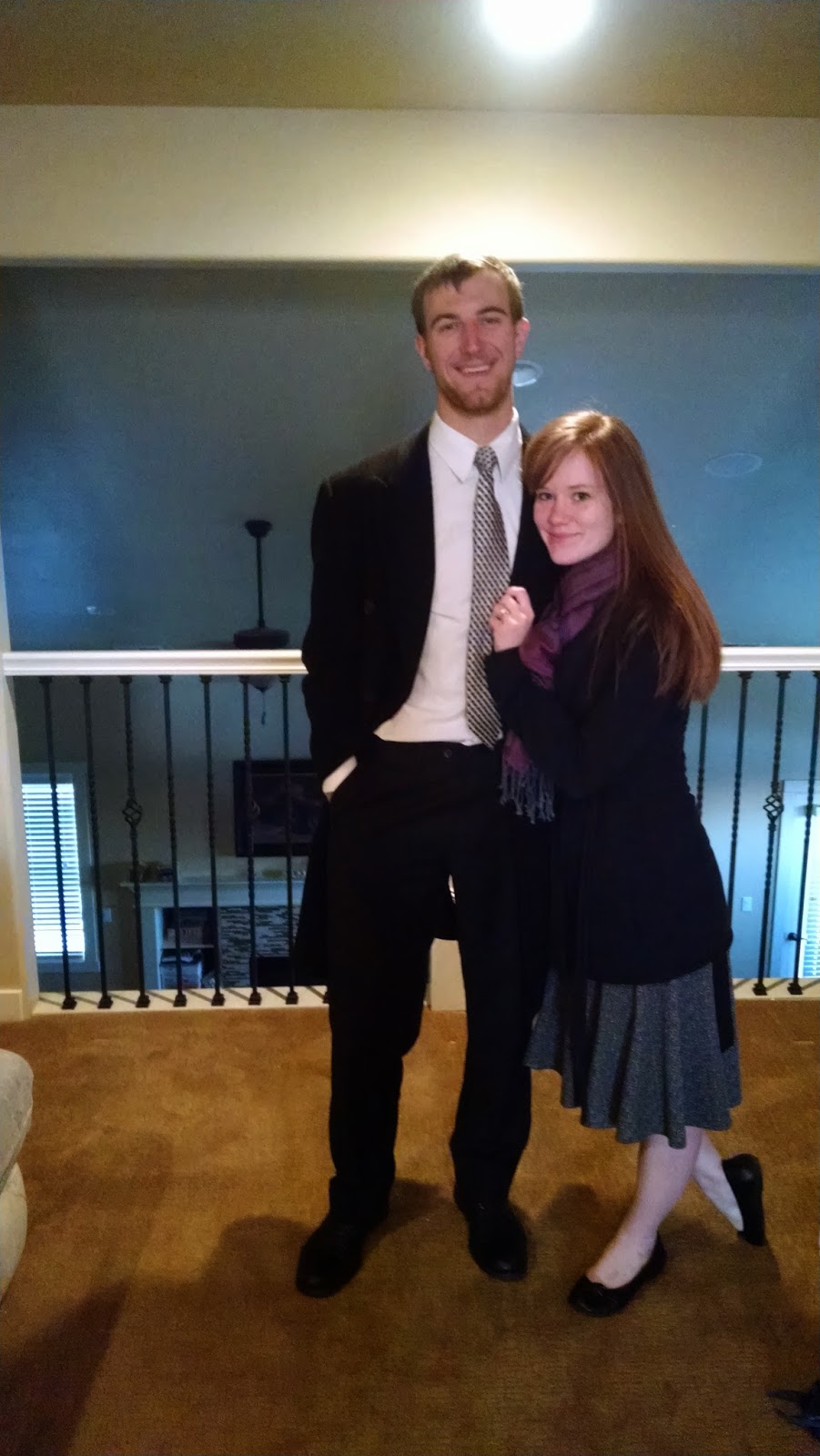
Almost a month since my last post, but here's my excuse: I got engaged! After dating on and off for years, and after Tyler has served a mission for our church, we are finally going to get married. The planning has taken over my life, and what free time I have I give to a manuscript I'm editing.

Tyler and me
I haven't even been able to read. I checked out a book and after renewing it once and still not finding time to read more than the first two or three pages, I decided to return it. The good news is that I have found a venue and a dress, we figured out the menu, and we have a florist, photographer, and my hairdresser all lined up. Things are calming down a little bit, so I have time to write this post.

The other good news is that while I haven't been reading, I still have to commute to work and I was able to listen to Joseph Heller's Catch-22 while I drove. So no, I wasn't completely deprived.

Besides my usual reason of wanting to be well read, I decided to listen to Catch 22 because nothing else at that particular library looked good and because I've never completely understood "Catch-22" as a phrase. It's a phrase used regularly in English, and I only had a hazy idea what it meant. So I guess you could say I listened to this book to improve my English fluency.

Turns out this is what a Catch-22 is.
The world makes sense again.
I was listening to one CD from this book for a while before I looked over at the player and saw that it was set to random and I had been listening to it out of order. That's something you would normally realize straight off, but the fact that it took me so long lets you know just how random this book is. I didn't feel out of the loop, and I had been getting the story out of order. Another time, I thought it must be set on random, because I was a bit confused, but it wasn't. I turned it back a track and kept an eye on it and sure enough, I hadn't missed anything.

For that reason, and because it is written in vignette style--think episodes--I think this may just be a book that is better for listening than reading. I haven't read it, though, so I can't really say. I just know that it was an excellent commuter book because I was getting it in snippets and it was written in snippets.

Catch-22 reminds me of the sitcom M*A*S*H*. In the same way that Hawkeye is the main character of the sitcom, a man named Yossarian is the main character. What I mean by that: While the entire book isn't focused on him, he gets our attention more than the other characters.

It's a book set in WWII, with the regular cast of characters all belonging to an American bombing squadron. There are scenes where the characters are bombing various locations, there are scenes with them in Rome for some R&R, there are scenes in the hospital, and there are scenes out and about the squadron's base. If you like M*A*S*H*, I'd give this book a try. From what I remember, they are similar in content, interpretation of military bureaucracy and personnel, and sense of humor. Also, Yossarian reminds me of Klinger, minus the cross-dressing.

The characters are what stand out the most about this book. They are Dickens-like in that Heller took quirks and blew them up to create entire characters, making them more caricatures than realistic; yet somehow we buy it as being true to the world they exist in. Plus, this is the military and we are given to understand that everyone is a bit crazy. Character example: Colonel Cathcart, whose main attribute is his ambition without self-confidence. He is constantly concerned with whether an idea or event is a "feather in his cap" or a "black eye." Those phrases are used over and over again.

Early on, I could tell this book would have a unique ending. It couldn't be totally happy, because that wouldn't fit the tone of the book, but it couldn't be serious either, for the same reason. It would be a bizarre ending that somehow made sense. I wasn't disappointed, and that's all I'll say on that, because I really do recommend this as a commuter book (but perhaps not with kids in the car, because R&R means a lot of time with prostitutes).

As I said, though, I don't know if I would recommend this for reading. It would probably try your patience and you'd have to read it in short periods instead of sitting down for a good couple hours to read. The style is disjointed and the plot itself isn't clear until near the end.

Thursday, November 13, 2014

What's Elizabeth Reading? ...Laura Esquivel

I found this book because I wanted to read something written by an author whose last name started with the letter "e." I thought it would be nice to have at least one book per letter on my bookshelf, and "e" was the first letter to come up short. So I walked into the library and stood in front of the e's in the fiction section. This is the book that stood out to me -- I don't read much Hispanic fiction (this was in English, a translation, and I tend to think Laura Esquivel wasn't so careful with her wording that I got the short end of the stick because of it), and the title was familiar: Like Water for Chocolate.

This is a strange and seemingly hypocritical post to put up after my post about when and why I stop reading particular books, mainly because there is a ton of sex in this book. I didn't think it was that bad until last night, when I read the ending to my boyfriend and realized that while the sex itself wasn't described minutely, various aspects of sex were mentioned (climax, heat, etc.). This is what I get for reading a modern romance novel.

Like Water for Chocolate is part cookbook, part romance, and part coming of age story. We watch Tita as she grows up cooking and serving her overbearing, constantly dissatisfied mother, who is determined that Tita will never marry because as the youngest daughter, it is her lot to serve and take care of her mother until her mother dies. So when Pedro comes to ask for Tita's hand in marriage, he is instead prodded into marrying Tita's sister.

Esquivel's story reminded me of Chocolat, by Joanne Harris, in that the food Tita makes is mildly magical. If she is feeling sad while she makes it, those who eat it will likewise feel sad. The same thing goes with whatever emotion she is feeling at the time.

What doesn't work for me in this book is how it skips forward in time without notice and sometimes skips key events, instead glossing over them with a sentence or two to tell the reader what happened. I assume that Esquivel had a reason for this decision, but I cannot tell what it is besides possible laziness or a desire to keep the story short.

The writing was good enough that I did not notice it much. I was confused, however, about how there was one recipe per month but the narrative didn't keep to that calendar. At that point, what is the purpose of having a calendar layout? Why title a chapter "January" if it does not all take place in January, and then why skip a couple years between that and February? Formatting. Esquivel needs to explain herself a bit.

Right of the reader: to not have to think or question, to not be drawn out by any flaw or irregularity in the text. If they want to think, they can, but they should be able to understand at least the events of the story without pondering or figuring them out. Esquivel's time habits gave me a little bit of a jerky journey.

Sunday, November 9, 2014

When and Why I Put Down a Book

I’ve taken to listening to books on CD while I drive to work lately. The drive home takes 25 or so minutes. On the way to work, though, let’s just say I have to leave 45 minutes early just in case.
It was after I decided to stop listening to one particular book that I thought it might be a good to talk about when and why I make that decision.


Why: It has descriptively sensual material

This is why I stopped reading The Color Purple midway through. I picked it up because it’s a well-known book and a classic. I thought it would be a good idea to read it so I could expand my literary foundation. But when the book began to talk, descriptively, about sex, I decided I needed to put it down. I’m one of those people who closes my eyes during movies because I don’t want to see what is happening on the screen when Character A shoves a pair of tongs through Character B’s eyes. It’s an image I don’t want in my mind, and with movies, I can close my eyes and still know exactly what is going on, so I don’t lose any of the plot. With books, you can’t close your eyes, and when it comes to sex scenes, I as a reader am being forced to conjure up images on my own that I’d rather not be creating or even thinking about. I'm okay if I'm told the characters had sex; just don't describe it. I’m not against sex. Like, at all. I think this particular reason for putting a book down has to do with my relationship with God, and how I believe that He wants my thinking to be virtuous. Getting my brain to conjure up its own porn is not so cool when the people involved aren’t me and my spouse. It does things to the way your mind works and makes sex more about lust than physical intimacy and love.

When: If it is a recurring scene and/or I can’t skip the page/chapter without losing what is happening in the story

I wanted to read Neil Gaiman’s American Gods. It sounds like a brilliant concept, and besides that, people say it’s great. But when an entire introductory chapter was a single sex scene (an erotically horrific one, if that interests you), I could tell that things weren’t going to go up from there. So I made the choice to stop reading it. I think I allowed The Color Purple one sex scene but then it kept dwelling on it and returning for more and I was just done with it all.

Why: The ideas are an assault on my religious beliefs

I’m okay if an author has different ideas than me. Really. By the time I was finishing reading Marion Zimmer Bradley’s Mists of Avalon, I had a weird sensation that the narrator had been trying to convert me to her religion. On a whim, I looked it up and it turns out Bradley did actually start a religion along the lines of the one found in the book (practiced by the book's Morgan le Fay, by the way). It’s called the Aquarian Order of the Restoration, if you feel like looking it up. This conversion attempt did not make me need or want to put the book down.

A book I did end up putting down was Philip Pullman’s The Amber Spyglass. I adore the first two books in the His Dark Materials trilogy. They are some of my favorite YA novels. But when I got to the third book in this trilogy, the tone of the books turned and I found myself being served some religious theory that said God was a liar. It was as if the fiction was being used to mask a rant about how blind religious people are. Things crossed a line for me when I started wondering if he was right. Go ahead and say I am deliberately blinding myself to reason, but I know there is a God and He is a good person, and I don’t have to sit and quietly accept an attack on that belief. In a lecture or classroom, fine, because I can defend myself. A book isn’t that sort of platform.

When: If I start giving undue credence to the author’s argument

Again, this is an Elizabeth-is-willfully-being-blind moment. I don’t care.

Why: The writing is terrible

I once bought a book at a library book sale that had what I thought was a promising concept. It was a retelling of Jane Eyre from Adele's point of view that claimed Bertha wasn't insane after all and Adele was friends with her and was the reason the house burned down. However intriguing the concept, though, this writing was terribly hard to get through and the story just wasn't worth that much work.

When: If the writing gets in the way of the story

The story is what's important. If I have to trudge through a swamp to get to it, that story better be worth it. I'll put a book down if the writing is so bad it slaughters the story.

Why: The book can't hold my attention

I tried multiple times to listen to Around the World in 80 Days. It isn't that Jules Verne disagrees with me, because I made it through Journey to the Center of the Earth just fine, but for some reason I never could get past the beginning of 80 Days, and I was listening, which is generally easier. I may have to try again sometime soon.

When: If it's due back at the library

If it is due back, or if another book grabs my attention instead, I'll let the book go. Whether or not I renew it and give it more time has to do with how good of a recommendation the book has. After all, it could just have a slow beginning.

Think of it this way: I want a PG-13 at most (I'll give a bit on language and violence, so long as there's a reason for it being there) book that is well directed and has a good script. That's my base standard.