I read "To Kill a Mockingbird" in high school, but didn't remember most of it. When Harper Lee passed away, I figured it was time to revisit the book in memoriam of her.
Interesting, by the way, for an author whose book prominently featured a social recluse to be a social recluse herself.
The main thing I found myself focusing on while reading this book, like when I read Anna Karenina, was what the book is about. When you hear about "To Kill a Mockingbird," the primary discussion is about race, with particular attention paid to Tom Robinson's trial. For those who have not read it: The book is set in Alabama in the 1930s, and Tom Robinson is a crippled black man who was accused of raping a white woman. It goes to court and Atticus Finch becomes one of the most famous lawyers in literary history by defending him and asserting the charges are a lie.
Seriously--I just Googled "most famous literary lawyers," and the first result was titled "The 25 Greatest Fictional Lawyers (Who Are Not Atticus Finch)."
That being said, I kept expecting the trial to come up sooner. The first time I see it being alluded to is on page 74 (out of 281), and the entire episode comes to an end on page 241. That's 114 pages without Tom Robinson's case in it, and that's two-fifths of the book. How can that be the focus of the plot as a whole?
Instead, Arthur "Boo" Radley caught my eye. His pages are fewer, but are bunched up mostly at the beginning and end of the book. Boo is prevalent on pages 3-72 and again on pages 263-279, a total of 85 pages, half what Tom Robinson got. So why did he stick out? He got prime real estate: the beginning and end.
Boo is the social recluse I mentioned earlier; a man who no one ever sees, though they know he's still alive because they haven't seen his corpse being taken away. He is an object of fascination for the children, Scout, Jem, and Dill.
There are also portions of the book dedicated to an old woman with a morphine addiction who is grumpy and mean as can be, Hitler, the education system, a mad dog, poor white people, the supposed importance of having an old family and sketches of many other people in town.
The running thread I found, framed by Boo, is prejudice and hypocrisy. It is not just racism; it's bigger than that.
Toward the end of the book, Scout, the narrator, begins questioning why people treat each other the way they do. Hitler is the biggest example; she wonders why people look down on black people yet despise Hitler for looking down on the Jews.
In short, this seems to be a book people are striving to live by today. Its philosophy of being polite and honest to everybody, no matter what, is the epitome of contemporary virtue.

Saturday, April 30, 2016

Saturday, April 23, 2016
Analysis exercise, Alice Munro
Retyping, an exercise in noticing how a writer writes. Today, I'll retype a passage from Nobel Prize winner Alice Munro's "Free Radicals," which was published in "The New Yorker" in February 2008, then analyze it.
At first, people kept phoning, to make sure that Nita was not too depressed, not too lonely, not eating too little or drinking too much. (She had been such a diligent wine drinker that many forgot that she was now forbidden to drink at all.) She held them off, without sounding nobly grief-stricken or unnaturally cheerful or absent-minded or confused. She said that she didn't need groceries; she was working through what she had on hand. She had enough of her prescription pills and enough stamps for her thank-you notes.
Her closer friends probably suspected the truth--that she was not bothering to eat much and that she threw out any sympathy note she happened to get. She had not even informed the people who lived at a distance, to elicit such notes. Not Rich's ex-wife in Arizona or his semi-estranged brother in Nova Scotia, though those two might have understood, perhaps better than the people near at hand, why she had proceeded with the non-funeral as she had done.
Rich had told her that he was going to the village, to the hardware store. It was around ten o'clock in the morning, and he had just started to paint the railing of the deck. That is, he'd been scraping it to prepare for the painting, and the old scraper had come apart in his hand.
She hadn't had time to wonder about his being late. He'd died bent over the sidewalk sign that stood in front of the hardware store offering a discount on lawnmowers. He hadn't even managed to get into the store. He'd been eighty-one years old and in fine health, aside from some deafness in his right ear. His doctors had checked him over only the week before. Nita was to learn that the recent checkup, the clean bill of health, cropped up in a surprising number of the sudden-death stories that she was now presented with. "You'd almost think that such visits ought to be avoided," she'd said.
If you want to read the full thing, you can, for free, here.
Here is what I noticed. First were the lists in that first paragraph. I could just imagine those phone calls, with people on the phone not knowing what to say. How are you? She gives a short answer. I'd understand if you're depressed, they say. No, I'm fine, thank you, she replies. Would you like some company? I'm sure you're lonely. No, I'm fine, thank you. Et cetera. Awkward conversations on both sides, the sort of conversation that ends in a sigh of relief for them, that they did their duty of reaching out to her, and a sigh of relief for her that they've finally hung up to leave her alone. The use of a list also makes it feel like everyone asks the same set of questions, and she could almost check them off on her fingers as the conversation goes on.
I also noticed the repetition of "too." They obviously expect her to be depressed, lonely, etc., but just want to make sure it isn't serious. Is she fine enough that they don't have to do anything to help? It is as if they are essentially checking to make sure she doesn't commit suicide.
Also, the use of the "At first" that the story starts with--it shows that people were interested right after the death, but soon turned their attention to other things (a problem I think we all have, sadly). The phone calls stopped or changed in content before too (haha) long.
As for the "drinking too much" bit, it illustrated, before Munro spelled it out, that these people barely paid attention to her before the death. They didn't know her or care enough to remember that she doesn't drink at all. I'm sure the switch from drinking often to not at all was a life event for her and those people who were truly in her life would have known about it and remembered.
The second list is her list: Don't sound grief-stricken. Don't sound unnaturally cheerful. Don't sound absent-minded or confused. She must be a self-conscious woman who cares about the impression she gives to others. Or she doesn't want to do anything to make them concerned and stay on the line (which is more likely).
Oh, and the "held them off" is a nice touch.
After a public view in the first paragraph, we zoom in to see her actual friends. We get a view of what is actually happening, and we learn her husband's name. I had assumed from the first paragraph that her husband had died, mainly because she was apparently living alone, she was old, and something tragic had happened to her. This is the paragraph where we definitively learn there was a "non-funeral." That comes right after learning she didn't tell the non-family members (telling us she and her husband didn't have much by way of true family, but had lived alone). If they had had true family members, they would have been mentioned in this paragraph.
By the third and fourth paragraphs, we zoom in enough to see what had actually happened. Note the details used, things that symbolically mean little but add reality to the event: He was scraping old paint off the deck when he went to the hardware store and died by a sign out front that was trying to sell lawnmowers. This is not a death she has romanticized at all (a common trait in contemporary fiction).
This may seem like a small detail, but she wrote out "ten o'clock in the morning." There are so many ways to show the time, from the newspaper's "10 a.m." to "10:00 a.m." or "ten in the morning." Contemporarily, people will even just write "10." But no, it's written out here. I'm not sure if that is because of "The New Yorker's" style, but even if it is, writing it out longhand points to her age and temperament. She isn't so anal or grief-stricken as to know the exact minute, or even to know if it was 10:30. She writes out "in the morning," which is not the utilitarian "a.m." and is reminiscent of an older style. People rarely even say "o'clock" anymore, have you noticed?
In a nod to possible symbolism, the old scraper had "come apart in his hand." Practically, it could mean he was having a hard time with the scraping because he's in his 80s. It could also be that the scraper was just old and gave out--like he did.
In that final paragraph I gave you, I love the detail that now everyone is telling her sudden-death stories. This is exactly what happened to me when I last visited my grandma's cousin, who lives near me. I visited to tell her that her brother had died, and at some point in that visit she started telling me stories about how people in our family have a history of simply dropping dead. It was mildly concerning.
I'm sure that people were telling Nita stories about other deaths because they were trying to show they understood. I've noticed that when someone says x happened to them, the people around them start chirping in about how they've had the same experience, except this was how it was different. It must have something to do with a sense of community.
Last comment on the story: "You'd almost think that such visits ought to avoided," Nita says. "Visits" could mean either visits to the doctor or visits to people in mourning. Munro did a nice job of using one word to say two things at once.
I share this analysis for two reasons. 1) It was a good exercise for my reading skills. 2) If you read enough analyses like this, you should be able to do the same thing, and that should improve your writing. Try doing analyses yourself sometime. You'll read more out of what you read.
 |
| This was the cover of the edition it was in. I love "The New Yorker." |
Her closer friends probably suspected the truth--that she was not bothering to eat much and that she threw out any sympathy note she happened to get. She had not even informed the people who lived at a distance, to elicit such notes. Not Rich's ex-wife in Arizona or his semi-estranged brother in Nova Scotia, though those two might have understood, perhaps better than the people near at hand, why she had proceeded with the non-funeral as she had done.
Rich had told her that he was going to the village, to the hardware store. It was around ten o'clock in the morning, and he had just started to paint the railing of the deck. That is, he'd been scraping it to prepare for the painting, and the old scraper had come apart in his hand.
She hadn't had time to wonder about his being late. He'd died bent over the sidewalk sign that stood in front of the hardware store offering a discount on lawnmowers. He hadn't even managed to get into the store. He'd been eighty-one years old and in fine health, aside from some deafness in his right ear. His doctors had checked him over only the week before. Nita was to learn that the recent checkup, the clean bill of health, cropped up in a surprising number of the sudden-death stories that she was now presented with. "You'd almost think that such visits ought to be avoided," she'd said.
If you want to read the full thing, you can, for free, here.
Here is what I noticed. First were the lists in that first paragraph. I could just imagine those phone calls, with people on the phone not knowing what to say. How are you? She gives a short answer. I'd understand if you're depressed, they say. No, I'm fine, thank you, she replies. Would you like some company? I'm sure you're lonely. No, I'm fine, thank you. Et cetera. Awkward conversations on both sides, the sort of conversation that ends in a sigh of relief for them, that they did their duty of reaching out to her, and a sigh of relief for her that they've finally hung up to leave her alone. The use of a list also makes it feel like everyone asks the same set of questions, and she could almost check them off on her fingers as the conversation goes on.
I also noticed the repetition of "too." They obviously expect her to be depressed, lonely, etc., but just want to make sure it isn't serious. Is she fine enough that they don't have to do anything to help? It is as if they are essentially checking to make sure she doesn't commit suicide.
 |
| This image went with the story online. It's attributed to Sam Weber. |
As for the "drinking too much" bit, it illustrated, before Munro spelled it out, that these people barely paid attention to her before the death. They didn't know her or care enough to remember that she doesn't drink at all. I'm sure the switch from drinking often to not at all was a life event for her and those people who were truly in her life would have known about it and remembered.
The second list is her list: Don't sound grief-stricken. Don't sound unnaturally cheerful. Don't sound absent-minded or confused. She must be a self-conscious woman who cares about the impression she gives to others. Or she doesn't want to do anything to make them concerned and stay on the line (which is more likely).
Oh, and the "held them off" is a nice touch.
After a public view in the first paragraph, we zoom in to see her actual friends. We get a view of what is actually happening, and we learn her husband's name. I had assumed from the first paragraph that her husband had died, mainly because she was apparently living alone, she was old, and something tragic had happened to her. This is the paragraph where we definitively learn there was a "non-funeral." That comes right after learning she didn't tell the non-family members (telling us she and her husband didn't have much by way of true family, but had lived alone). If they had had true family members, they would have been mentioned in this paragraph.
By the third and fourth paragraphs, we zoom in enough to see what had actually happened. Note the details used, things that symbolically mean little but add reality to the event: He was scraping old paint off the deck when he went to the hardware store and died by a sign out front that was trying to sell lawnmowers. This is not a death she has romanticized at all (a common trait in contemporary fiction).
This may seem like a small detail, but she wrote out "ten o'clock in the morning." There are so many ways to show the time, from the newspaper's "10 a.m." to "10:00 a.m." or "ten in the morning." Contemporarily, people will even just write "10." But no, it's written out here. I'm not sure if that is because of "The New Yorker's" style, but even if it is, writing it out longhand points to her age and temperament. She isn't so anal or grief-stricken as to know the exact minute, or even to know if it was 10:30. She writes out "in the morning," which is not the utilitarian "a.m." and is reminiscent of an older style. People rarely even say "o'clock" anymore, have you noticed?
In a nod to possible symbolism, the old scraper had "come apart in his hand." Practically, it could mean he was having a hard time with the scraping because he's in his 80s. It could also be that the scraper was just old and gave out--like he did.
In that final paragraph I gave you, I love the detail that now everyone is telling her sudden-death stories. This is exactly what happened to me when I last visited my grandma's cousin, who lives near me. I visited to tell her that her brother had died, and at some point in that visit she started telling me stories about how people in our family have a history of simply dropping dead. It was mildly concerning.
I'm sure that people were telling Nita stories about other deaths because they were trying to show they understood. I've noticed that when someone says x happened to them, the people around them start chirping in about how they've had the same experience, except this was how it was different. It must have something to do with a sense of community.
Last comment on the story: "You'd almost think that such visits ought to avoided," Nita says. "Visits" could mean either visits to the doctor or visits to people in mourning. Munro did a nice job of using one word to say two things at once.
I share this analysis for two reasons. 1) It was a good exercise for my reading skills. 2) If you read enough analyses like this, you should be able to do the same thing, and that should improve your writing. Try doing analyses yourself sometime. You'll read more out of what you read.
Saturday, April 16, 2016
Dictating - what a concept
If I were an English teacher, I would allow people to turn in audio essays.
Now, I understand that English teachers are supposed to teach proper punctuation and spelling, but everything else they are teaching by assigning written essays -- grammar, sentence fluency, argument structure, different poetic tools, etc. -- can just as easily be worked on in a verbal form as in a written one.
It may make it tricky to grade or to give feedback on, so here's how it would go: Students would record an audio essay, then follow-up with an assignment to write it out and critique it.
My reasoning is that there are many people who have trouble writing. They have thoughts they can voice aloud, but confronted with a page, everything goes haywire. The dictation method bypasses this issue and allows a person to simply voice their thoughts aloud.
Typing it out forces a person to look at how they sound (an excellent tool if you're trying to become a better speaker). Past the umms and pauses, they should receive a confidence boost in their ability to write an essay. They just dictated one, after all, and that's no different from writing.
Maybe, just maybe, this would allow someone to learn how to write. They could then learn to speak with their hands instead of their mouths, because that's all writing is. Perhaps it would help them get past the page barrier.
All of this said, it's time to give a life update. I'm leaving my job at the Idaho Press-Tribune in a few weeks. I'm moving to Utah, then starting a business helping seniors write their memoirs through dictation. The memoirs will be collected into a book and printed for their family members.
So I'm not an English teacher, but I'm going to try my hand at turning this audio essay idea into a business. Wish me luck -- I'm sure you'll be hearing about it.
Now, I understand that English teachers are supposed to teach proper punctuation and spelling, but everything else they are teaching by assigning written essays -- grammar, sentence fluency, argument structure, different poetic tools, etc. -- can just as easily be worked on in a verbal form as in a written one.
It may make it tricky to grade or to give feedback on, so here's how it would go: Students would record an audio essay, then follow-up with an assignment to write it out and critique it.
My reasoning is that there are many people who have trouble writing. They have thoughts they can voice aloud, but confronted with a page, everything goes haywire. The dictation method bypasses this issue and allows a person to simply voice their thoughts aloud.
 |
| I searched "dictation" on Freepik.com and got this. No idea why. |
Typing it out forces a person to look at how they sound (an excellent tool if you're trying to become a better speaker). Past the umms and pauses, they should receive a confidence boost in their ability to write an essay. They just dictated one, after all, and that's no different from writing.
Maybe, just maybe, this would allow someone to learn how to write. They could then learn to speak with their hands instead of their mouths, because that's all writing is. Perhaps it would help them get past the page barrier.
All of this said, it's time to give a life update. I'm leaving my job at the Idaho Press-Tribune in a few weeks. I'm moving to Utah, then starting a business helping seniors write their memoirs through dictation. The memoirs will be collected into a book and printed for their family members.
So I'm not an English teacher, but I'm going to try my hand at turning this audio essay idea into a business. Wish me luck -- I'm sure you'll be hearing about it.
Saturday, April 9, 2016
Final flash fiction attempt: "Existentialist"
My final flash fiction attempt for the writing contest I entered was the attempt I submitted (and was rejected based on). I originally titled it "Oranges," but switched to something like "Existentialist."
This feels like the perfect night to dress up like hipsters. At least, that’s what everyone else at the Flying M seems to have decided tonight, except me. Me and the woman at the table by the large windows, that is.The reason for the title change was an attempt to make this scene more "compelling," which was a criteria it was being judged by. When I wrote this, it was mostly in a poetic frame of mind and I wasn't going for a message in particular beyond "stillness is good."
She’s wearing a blue dress without sleeves, and she’s been sitting there for over an hour, writing poetry on orange peels with hands decorated by three ring tattoos and veins that are raised rivers, belying an age that is greater than her dress, red purse, or orange peel scrawls.
“It’s as if the trees were whispering,” she’s written on one, a strip discarded near her elbow that I saw on my way to throw out my drink.
A glance out those large, garage door-style windows shows it’s still raining beneath the trees outside, and I wonder what they are trying to say.
But as I wonder, the woman gets up, slipping her oranges into her bag and leaving a tip on the table. I see her step into the evening and stop beneath a sidewalk tree to touch its trunk with one of her river hands, skin like paper and rings like old promises, as if to bid it farewell.
As far as I know, the tree does not answer, but she smiles anyway and it’s a quiet smile, a poet’s smile. She reaches back to free her hair from its clip and it falls in sheets, pulling back in the wind and settling down her back before she turns from the tree and clicks down the sidewalk.
I glance at the hipsters one last time before I check the time and see I should be getting home. On my way to my car, I too stop by the tree and place my hand on its trunk, cold and hard and startlingly white. No words, but perhaps the quiet is a message of its own.
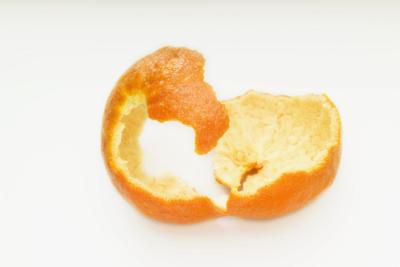 |
| Found on Livestrong.com. I'm betting she was writing with a permanent marker. |
The writing friend I asked for advice on this piece said something along the lines of, "So the weirdo writes on oranges and touches trees. So what?"
So what, indeed. I did some staring at it and decided it could be considered an existential work. Once something is assigned a philosophy, it automatically gets more credence, right? It's existential because this woman is being her own self and not caring what others think. The narrator is wondering why she is different, and a backdrop of hipsters--a stereotype that loves to philosophize and be individual, yet seeks community and sameness with other hipsters--helps to emphasize how she does not fit a label. (Unless you have an adequate label for an orange-peel poet?)
Does that make it compelling for you? I found it compelling, if only because of the poetic ambiance and beautiful imagery. But then, I'm of the (minority) philosophy that art does not need meaning.
As for dissecting this story, then. The first line was given by the contest organizers, and it reminded me of a local coffee shop, the Flying M Coffeegarage, where small bands often play and people gather to have leisurely conversations. I've had a couple newspaper interviews there, myself, one of them with a philosophy professor who chose the place. I don't know that I have seen hipster-esque people there, but I placed this story there for the hipster environment.
That said, the setting details are correct and true to life, except that I have no idea what trees are outside the place. I doubt there are aspens, which is what I used, but I'm sure I got away with it. I appeal to "Inception," where the girl is told to only use details from actual places, not complete real places.
The woman was in the audience at a reading I attended during the Death Rattle Writers Festival. I took a photo of her, but it didn't do the impression justice, so instead, I wrote this down in my writer's notebook:
And then you see her hands, and the backs of her palms are thin, the bones showing through and the blue of the veins near enough the surface that they could be a raised river and she is old, older than her style of dress or her soda choice or the length of her hair, which reaches down to the bra line in curves. It is brown, and her dress is blue and white and the heels she wears remind me that my mother, not yet fifty, rarely wears high heels. They hurt her feet, she says. Perhaps this woman keeps her age in her hands, arthritis and chafing skin and calloused fingertips, instead of her dress, hair, soda or feet. I keep mine in my shoulders, age counted in 40-hour weeks spent leaning closer to a computer screen.Paragraph nonfiction.
Anyway, I borrowed that woman because I was going through my writer's notebooks for ideas and she stood out to me. The ring tattoos come from a student in one of my college classes back in the day--another interesting detail I'd recorded in a writer's notebook. The orange peel poetry was also in my notebook. I have no idea where it came from, but I think I may have stolen it from someone, or else it came from a classmate peeling an orange in English class. Not sure which. But see how useful those notebooks are?!
Note on stealing things in writing: Totally fine, so long as you make it your own. Don't steal wholesale. A guy once tried to borrow pieces of my husband's love poetry to me and mine to him, because he came to us for love poetry advice and we used personal examples. It didn't go well for him. Rang completely false and didn't flow. For the record, that relationship did not last.
Back to the subject at hand. My friend's criticism of the story remains: This story is lacking in conflict. I think it is complete the way it is and would actually like to change the title back to "Oranges." What do you think? Is it compelling? Does it make you care?
Saturday, April 2, 2016
Third flash fiction was like the first all over again
And now for the third flash fiction attempt (I don't know that these got significantly better as I continued on writing them):
I wanted to capture that moment—back to that approach—when a woman realizes she is going to be a mother. I am sure it is terrifying, exhilarating and altogether overwhelming.
I love this painting by Raphael Soyer. It's of the annunciation, the moment where an angel comes to the Virgin Mary and says, “Hey, you're pregnant!” I think of it as being just a few minutes after the angel leaves. How was Mary feeling? Probably withdrawn, if nothing else. My mom, if I remember right, thought Mary was the woman in the blue. I think Mary is the one with the purple skirt. Either way, it's a powerful painting.
My flash fiction attempt did not at all measure up to this painted pregnancy moment, but then, it was mostly about someone feeling lonely. I don't know that Mary was feeling lonely quite yet (but later, shunned as a pregnant woman without a husband? I'm sure of it).
This story comes off as a little immature to me. Would you agree? Something about how indecisive she is reminds me of high school. So no, this girl is not ready to be pregnant, in my opinion.
Just like with my first flash fiction attempt, I used glimpsed memories to bring life to a person who is not the narrator. As you can guess, a lot of it is from my own life. I don't think the story sucked the reader in enough to make that work, though. It's more of a cheap trick at this point.
The same stuff I said about the first flash fiction goes for this one, though. It's basically the same story, just with different words and a different oh-you-poor-thing ending.
Lesson learned: Don't put multiple memories in one flash fiction piece, building up to a revelation. That story structure does not work. Why? It doesn't resolve, and the build-up seems contrived, unnatural. I'm not sure why it doesn't seem natural, but both stories rang false.
I don't think I was impressed with this one even when I wrote it. My favorite was the one about the oranges, which I'll go over next week.
Jessie is a friend. At least, I think she is. Candice is a friend and Audrey and Donna and Kate and Sara - but Jessie, I don’t know.No, I'm not pregnant (though a friend of mine thinks I should change that. Won't happen soon). This idea came into being while it was being written, and at the end, I realized she needed a reason for her best friend, and pregnancy came to mind.
I don’t know because when we stood in line together in the second grade, she only talked to the new girl, who was from Russia and therefore interesting. But that was okay. She gave me a pencil later, one with my name on it, and played wolves with me at recess.
I think Jessie is my friend because in middle school, when my grandma died and I first started hating flowers, she sat on my family’s deep freezer and held my hand.
Jessie is my friend because when I was a high school freshman with a crush on that boy in my geography class, she helped me think of ways to meet him then taught me how to curl my hair into pretty ringlets so he would notice me. And then, when he asked me to be his Facebook friend, she freaked out with me in the parking lot and we went out for frozen yogurt to celebrate.
Jessie was definitely my friend on the day that we graduated. We took photos together and laughed and high-fived our favorite teachers, then went to the after party and, well, and she left with that cute guy she had a thing for. But I know she was my friend because later that night, she called me to tell me what had happened - ALL of it.
But now I don’t know, because Jessie won’t answer the phone when I call, and this year, she forgot my birthday. I need to tell her something.
I need to say I’m pregnant and scared, and I could really use a best friend right now to hold my hand. I am not ready for this.
I wanted to capture that moment—back to that approach—when a woman realizes she is going to be a mother. I am sure it is terrifying, exhilarating and altogether overwhelming.
 |
| Raphael Soyer's portrayal of the annunciation. |
I love this painting by Raphael Soyer. It's of the annunciation, the moment where an angel comes to the Virgin Mary and says, “Hey, you're pregnant!” I think of it as being just a few minutes after the angel leaves. How was Mary feeling? Probably withdrawn, if nothing else. My mom, if I remember right, thought Mary was the woman in the blue. I think Mary is the one with the purple skirt. Either way, it's a powerful painting.
My flash fiction attempt did not at all measure up to this painted pregnancy moment, but then, it was mostly about someone feeling lonely. I don't know that Mary was feeling lonely quite yet (but later, shunned as a pregnant woman without a husband? I'm sure of it).
This story comes off as a little immature to me. Would you agree? Something about how indecisive she is reminds me of high school. So no, this girl is not ready to be pregnant, in my opinion.
Just like with my first flash fiction attempt, I used glimpsed memories to bring life to a person who is not the narrator. As you can guess, a lot of it is from my own life. I don't think the story sucked the reader in enough to make that work, though. It's more of a cheap trick at this point.
The same stuff I said about the first flash fiction goes for this one, though. It's basically the same story, just with different words and a different oh-you-poor-thing ending.
Lesson learned: Don't put multiple memories in one flash fiction piece, building up to a revelation. That story structure does not work. Why? It doesn't resolve, and the build-up seems contrived, unnatural. I'm not sure why it doesn't seem natural, but both stories rang false.
I don't think I was impressed with this one even when I wrote it. My favorite was the one about the oranges, which I'll go over next week.
Saturday, March 26, 2016
Sundance flash fiction analysis
My second flash fiction attempt looked like this. In my defense, it was late at night when I wrote it.
This story idea actually began with a tactic I saw another author use: alluding to something and then building on that allusion. I think I saw it in the short story "The Tik Tok Man," which referenced "1984" and basically said that was the world the story was set in. It is a brilliant tactic because you use tons of work done already and don't have to waste that time yourself. I attempted to copy it by calling the guy a "Dorian Gray boy," but then threw those benefits out the window by explaining it - gorgeous, dangerous. Sure, that might have more depth for someone familiar with "The Picture of Dorian Gray," but there is not much to add. I did not pull all I could have put of a tactic like this. I will have to try again sometime.
I used the Sundance Film Festival partly because I am familiar with it and partially because the first line I was using, one of the assigned possibilities, reminded me of it. Hipsters and Sundance go together. The art gallery they are in is a compilation of art galleries on Park City Main Street, a Sundance location, and the long staircase is another real detail I added in.
I threw this piece out because I did not think it was compelling. Outrageous, yes, but not compelling, and that was one of the characteristics the writing contest judges were looking for.
My writer friend who looked over it for me said the story was all over the place and needed simplification. She also said the descriptions didn't quite convey the feelings or the plot , and I totally agree. I knew this needed editing, if only to unify the voice, which is not consistent. I think that is where her details comment came from. The beginning is more poetic and the end was crude. As for simplofication, I think a unified voice would have made it seem less jumbled and chaotic.
Your thoughts? How could I have improved this?
“It feels like a perfect night to dress up like hipsters,” the Dorian Gray boy said. Gorgeous, dangerous, met him in a Park City art gallery during Sundance. Surrounded by paintings of mountains, forks bent into stick men, and a bronze Last Supper sitting in front of a window that opened onto an alley, we were the only two in there just then.Here's what I was trying to do: First, I wanted to write an actual story, not just a moment like I wrote last time. I put in a smaller haiku turn, with the wow-she-just-did-that ending, but it was not such a jarring turn as before.
It was the stupidest pickup line in the world, not even a pickup line, but I’m too easy and half an hour later saw me making out with him one steep street over in the middle of a looong flight of stairs. I figured it was Sundance. Might as well, right?
But that boy was the stupidest bad-word-my-momma-would-scream-if-she-heard-me-say I have ever met in my life, ‘cause a week later I caught him stealing more than just French fries and trying for more than just French kisses. And by that second part I mean he was trying to go all Bill Clinton all over my butt.
His pants were down and I was telling him no, this was too fast, we only met an hour ago, but man you did pick a pretty spot for this, on top of a mountain and secluded and all, and I respect you for that, and I like your nice car, too, we should just keep driving around in it or something.
That’s when he said, all hot and heavy, that it wasn’t his car, and that’s what I meant about the stealing more than French fries part.
There’s one thing my momma taught me that is the truest thing I have ever known: If you don’t want a man making love to you, pee on him.
After that, he jumped back enough for me to reach past him and open the door. He’d been leaning on that door then and so he lost his balance and fell out.
So yeah, I pushed him down the mountain. With his pants down.
Snow is pretty good for sliding on, especially when it’s steep and the snow is the dry sort that won’t stick together.
I drove away before I could see how far he went, though, and that’s a shame because it would’ve been hilarious on my Instagram. But at the time, I was more concerned about whether to return the car before or after cleaning up the pee in the back seat. Sundance problems.
This story idea actually began with a tactic I saw another author use: alluding to something and then building on that allusion. I think I saw it in the short story "The Tik Tok Man," which referenced "1984" and basically said that was the world the story was set in. It is a brilliant tactic because you use tons of work done already and don't have to waste that time yourself. I attempted to copy it by calling the guy a "Dorian Gray boy," but then threw those benefits out the window by explaining it - gorgeous, dangerous. Sure, that might have more depth for someone familiar with "The Picture of Dorian Gray," but there is not much to add. I did not pull all I could have put of a tactic like this. I will have to try again sometime.
I used the Sundance Film Festival partly because I am familiar with it and partially because the first line I was using, one of the assigned possibilities, reminded me of it. Hipsters and Sundance go together. The art gallery they are in is a compilation of art galleries on Park City Main Street, a Sundance location, and the long staircase is another real detail I added in.
I threw this piece out because I did not think it was compelling. Outrageous, yes, but not compelling, and that was one of the characteristics the writing contest judges were looking for.
My writer friend who looked over it for me said the story was all over the place and needed simplification. She also said the descriptions didn't quite convey the feelings or the plot , and I totally agree. I knew this needed editing, if only to unify the voice, which is not consistent. I think that is where her details comment came from. The beginning is more poetic and the end was crude. As for simplofication, I think a unified voice would have made it seem less jumbled and chaotic.
Your thoughts? How could I have improved this?
Saturday, March 19, 2016
Flash fiction retrospect - Jessie the traveller
As a review from last week: I entered a flash fiction writing contest, and I didn't win (whoops, I didn't mention that part earlier, did I?). I went through four different attempts. For my edification and yours, I thought I'd go through them one by one saying what I tried to do, what worked, and what didn't work. Here's the first one:
I injected this thing with reality in an attempt to make it seem real. As another gambit for realism, I gave it concrete details, namely the Facebook statuses and the driver's ed story. Concrete details are a secret to good fiction. You are much more likely to believe a lie if the details are precise and, well, detailed. Mine could have been better.
I also gave this piece a haiku turn. The reader is reading on and on about Jessie and who Jessie is, then I turn things around and reveal that these reminiscences are being shared because Jessie is dead. It was meant to give a depth of meaning to the whole thing, touching that part of my reader that has experienced a similar loss.
Problems: I did no showing, only telling. I think that is the major flaw here. We don't get to know Jessie except as a memory, which means we aren't sad when we find out he's dead. Nothing happens after that revelation, either, except that the person is sad, no matter how honestly that sadness is reported.
It would have been improved if I had elaborated on a single scene, not thrown out three half-hearted ones, and made Jessie a person. I need to make my reader, not just my narrator, care about the character.
I have a habit of using abrupt haiku turns, and from all reports they throw readers off. I think it may be because my thoughts stop and change direction that fast; do others'? The problem with this piece's haiku turn, though, is that the narrator knew all along it was coming up. It didn't come through true stream of consciousness (Good term to know. It's where the character thinks aloud in place of an organized narrator).
I threw this one out because it did not feel real. A writer friend of mine thought it was the most compelling of my options (for the record, she didn't read the third option, about the pregnant lady), but that the prayer to God at the end was jarring because it was so sudden. She also felt like it was the start to something, not a complete story unto itself, and I ended at the climax without resolving it. I concede all these points (she also said the story was about traveling, but I won't concede that point).
I didn't resolve it because for me, it was about that moment. What happens after didn't matter so much as capturing that feeling a couple mornings after a friend dies. I think I failed at capturing that feeling, since Jessie wasn't a real-feeling person, but that is beside the point. I didn't want to write a complete story, which is an issue. It was supposed to be a complete story, not a captured feeling.
Jessie is a friend. He is one of those do-everything types, the only person I’ve known who took a break from college to work on a cruise ship and see the world. Every day on Facebook, it was something different -- “Just me and Big Ben, no biggie,” “Bike tour in Puerto Rico. My legs are killing me.” “Sometimes I practice my studious look, but only when I am brooding over my kingdom from a castle in Ireland.” “Couscous! In Morocco!”First off, this piece includes several pieces of real people from my life. I have a friend who temporarily dropped out of college to work on a cruise ship, my aunt had the same teacher as me in driver's ed, that teacher had a story about a kid who didn't know what a red light meant, I love long talks and have had some similar to this, and my father-in-law is that sort of storyteller. The last bit is real, too; it's how I felt when a friend of mine died in college, and again when an old roommate of mine died more recently.
Back in high school, Jessie and I took driver’s ed together. The teacher was the same guy who had taught my aunt, so that was weird, but whatever. I remember the first time Jessie got behind the wheel, he had to ask the teacher what a green light meant. I’m serious. The teacher just laughed at him, like it was a joke, but when we got to a light and Jessie gunned it on accident the moment yellow turned to red, man, I thought we were all going to die.
When he got back, from the cruise ship, you know, we had one of those late night talks, the kind that start in a restaurant, then continue in the parking lot for an hour before finishing in someone’s basement when one of you falls asleep. Jessie could tell stories like none other. Dramatic pauses, sound effects, hand gestures. You ever known a storyteller like that?
I’d love to hear one of those again.
I just can’t pull myself out of bed today. Even when someone is physically gone, it’s different from when they’re gone gone. And my heart is too still to beat right now.
It’s like with the blankets over my head, I can pretend the world smaller.
Dear God, help me out of bed today. Please. I need your help.
I injected this thing with reality in an attempt to make it seem real. As another gambit for realism, I gave it concrete details, namely the Facebook statuses and the driver's ed story. Concrete details are a secret to good fiction. You are much more likely to believe a lie if the details are precise and, well, detailed. Mine could have been better.
I also gave this piece a haiku turn. The reader is reading on and on about Jessie and who Jessie is, then I turn things around and reveal that these reminiscences are being shared because Jessie is dead. It was meant to give a depth of meaning to the whole thing, touching that part of my reader that has experienced a similar loss.
Problems: I did no showing, only telling. I think that is the major flaw here. We don't get to know Jessie except as a memory, which means we aren't sad when we find out he's dead. Nothing happens after that revelation, either, except that the person is sad, no matter how honestly that sadness is reported.
It would have been improved if I had elaborated on a single scene, not thrown out three half-hearted ones, and made Jessie a person. I need to make my reader, not just my narrator, care about the character.
I have a habit of using abrupt haiku turns, and from all reports they throw readers off. I think it may be because my thoughts stop and change direction that fast; do others'? The problem with this piece's haiku turn, though, is that the narrator knew all along it was coming up. It didn't come through true stream of consciousness (Good term to know. It's where the character thinks aloud in place of an organized narrator).
I threw this one out because it did not feel real. A writer friend of mine thought it was the most compelling of my options (for the record, she didn't read the third option, about the pregnant lady), but that the prayer to God at the end was jarring because it was so sudden. She also felt like it was the start to something, not a complete story unto itself, and I ended at the climax without resolving it. I concede all these points (she also said the story was about traveling, but I won't concede that point).
I didn't resolve it because for me, it was about that moment. What happens after didn't matter so much as capturing that feeling a couple mornings after a friend dies. I think I failed at capturing that feeling, since Jessie wasn't a real-feeling person, but that is beside the point. I didn't want to write a complete story, which is an issue. It was supposed to be a complete story, not a captured feeling.
Subscribe to:
Posts (Atom)