Saturday, November 28, 2015

What's Elizabeth Reading? ...Mitch Albom

I just finished Mitch Albom's Tuesdays with Morrie, a book I picked up because my in-laws had it on a bookshelf. In retrospect, it was a relevant book for the Thanksgiving holiday.

Tuesdays with Morrie is a best-selling nonfiction book about Albom's experience learning about life and death from an old sociology professor of his, Morrie Schwartz. I read it in two days, with plenty of pause time, and so I would not say it is a hard read or a dense one. It is simple; but then, I am sure Morrie would argue that is because life is simple.

Before I critique this, let me say I enjoyed the read. I looked up Morrie while reading and am waiting for a better time to watch the TV segments on him that were recorded before his death.

The writing is, as I said, simple and easy to understand. There are aphorisms, stories and humorous bits. As mentioned in Writing Tools, that how-to-write book I am going to discuss (can we say this begins the discussion?), Albom employs short sentences, with an uncomplicated structure, to tell truths. Short and to the point makes people think of it as true and indisputable, Writing Tools says, if I remember right without having it in front of me (I am still at a brother-in-law's, typing this on my phone as my toddler nephew bumbles around the room).

Take the last portion of the first paragraph as a sample:

The last class of my old professor's life took place once a week in his house, by a window in the study where he could watch a small hibiscus plant shed its pink leaves. The class met on Tuesdays. It began after breakfast. The subject was The Meaning of Life. It was taught from experience.

This device was used throughout the book, but usually not in quick succession like it was here. You get the idea, though. It worked well for a story trying to tell simple truths. It made them instantly more accessible and acceptable. I never tried to argue with him.

My primary question about the book is how much of it is fudged. When writing creative nonfiction such as this, small details are often fictional. The color of shirt Morrie is wearing, what the weather was like, that sort of thing. Two instances seemed a bit too clean-cut to me: One is when Morrie pulls out a plant to look at while talking about life and how everyone dies. Useful prop to visualize things for a reader, eh? The other is that while Morrie is dying and wants love and attention, there just so happens to be a parallel character -- Albom's brother. He is also terminally ill but does not want any attention whatsoever, completely ignoring all phone calls. Until after Morrie dies, of course, when he finally allows contact. It's just a little too convenient for truth, don't you think? But maybe it is true. Who would be heartless enough to lie like that for cash?

My primary discontent with the book is it doesn't teach life lessons, it tells them. Life lessons are not taught through aphorisms, but through experiences. I suspect this book could only change a life that is ready for it. If life has been trying to teach the same lessons it tells, this might incite the moment of epiphany. Otherwise, I bet people come away from it like I did: "Well, that was a nice, uplifting read." No life changes, no teary phone calls, no new resolutions.

This is why for self-help or inspirational, I prefer fiction. It is easier to experience lessons that way. Easier to write them so that the reader becomes immersed. It can be done in nonfiction, but Albom didn't manage it.

Saturday, November 21, 2015

Identity crisis

I had a small identity crisis a few weeks ago.

Ever since I was a child learning how to write, I have written stories. The first one I recall was about a fish who wanted to save a spider who was caught somewhere on land. Another used my uncle's pig for inspiration - I don't remember what it was about, but I know it was titled "Robert the Pig and His Sweater."

From the beginning, it was stories. Fictional stories, that is. Sure, I kept a journal, but I never considered that writing practice. I actively wanted to never work for a newspaper. I wanted to be a novelist.

College hit, and I wanted a job where they would pay me to write, or at least edit, so I applied for Accent editor and Opinion editor without knowing the job description for either. I just knew I did NOT want to be a reporter. At all.

The entire time I worked for the student newspaper, I did not write an article, not a single one, and I worked there for three and a half years.

I left college with the goal of finding a job where I would use my degree, and I ended up at a newspaper again.

I have since written numerous articles. I am not technically a reporter, but I do report. A few weeks ago, I had the realization that I am a journalist and I mainly write nonfiction. As I said, it was a moment of crisis, and I'm not exaggerating.

Who am I as a writer?, I wanted to know. It seemed like this blog and some meager scraps of other writing were all I had to cling to for my "fiction writer" dream.

To end this crisis, I did a couple things. 1) I told myself that people love my nonfiction writing at the newspaper. It makes people happy, even though it may not seem grand. Or fictional. 2) I am now looking at my job as a second school of writing. I am learning a new form and gaining practice and skills in writing that will transfer over when I am finished with newspapers.

I also read yet another how-to-write book, this one called "Writing Tools" and written by Roy Peter Clark. I finished it recently (a good newspaper word that makes something see timely even when it is starting to overripen) and will share my notes with you over the next few weeks, along with explanations to flesh them out.

P.S. - Being a journalist isn't THAT bad, is it?

Saturday, November 14, 2015

What's Elizabeth Reading? ...K.W. Negaard II

I read Kenny Negaard's book "Clarence: Adventures in the Great Wood" for my work. I didn't have high hopes for it, mainly because I'm skeptical of local writers. But I was wrong. This is actually a pretty good book.

For a cool backstory on the writer, read the story I wrote for the Idaho Press-Tribune. In brief, Negaard served in the military, wrote the book, then experienced extreme PTSD and landed himself in jail. He thinks that's where God wanted him to be, though, and he wouldn't have had it any other way. He's out of jail now and doing well. The story is pretty cool, so you should give it a read.

"Clarence" is about a caterpillar who becomes best friends with a robin, Tilly, and they decide to be roommates. They find a home, meet people and wait for the day when Clarence will get his own wings, but in the meantime, he flies around on Tilly. It has a bittersweet ending and is a sweet, religious-in-tone story. I honestly think young children would enjoy it if they are in the I-just-started-reading-chapter-books stage and love animals.
Clarence book cover
By "religious-in-tone," I mean there are frequent references to the Creator and how He watches over and has provided for all of us. It isn't preachy, though there are moments where spiritual stories are shared.

The writing is okay, not necessarily impressive, but I was impressed with Negaard's grasp of story structure (especially since I struggle with it so much). There is a first climax (finding a home), build up, and a second, larger climax, along with adventures along the way. The conflict for the story starts as being "I'm young and don't know anything" and morphs into "Someday, Clarence will get his wings. What will they be like? How does the transformation happen?" There are mentor characters, a frog and a raccoon, and squirrels provide comedic relief. All the elements to make a story are there, and I actually asked him if he had any writing training. He doesn't, but he has figured out the idea of having a writing schedule, which many non-serious writers don't attain (and thus they don't write anything).

He is planning on turning it into a series, with different books starring different characters, so keep an eye out if you purchase this book and enjoy it.

Saturday, November 7, 2015

A study in conflict

I've read a couple essays/articles about conflict today, and here is what I gained:

Conflict is about character.

I always put it in its own category, but maybe it is just a facet of a character. C.S. Lakin, an author who also wrote this essay on conflict, says conflict is shaped by the things a character values. Take that thing away or endanger it, then build a story as the character struggles to regain it.

Examples:

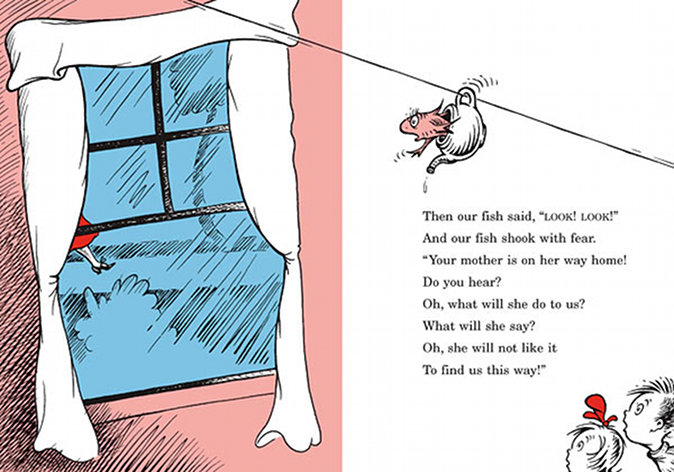
Dr. Seuss's The Cat in the Hat: Little boy wanted house to be clean and chores done before Mom gets home. This is challenged by the appearance of the cat, who proceeds to ruin everything.

Crisis moment.
Charlotte Bronte's Jane Eyre: Lady wants to be righteous and have worth. This is almost fulfilled by a man who falls in love with her ... except he's already married. Also challenged by the perception of her aunt.

Roald Dahl's The BFG: Giant runt doesn't believe in eating humans. This is challenged every day as he watches the other giants go out to eat them.

Point made? As I said, I had always thought of conflict as separate from character. It turns out that you grow a character, and then a conflict comes from/in relation to the character.

So what did my Settled character value? ... It seems he valued his marriage, and he enjoys normalcy instead of lunacy. Apparently, then, the conflict should have been something threatening his marriage. The lunacy thing was a bit of a sideshow, really.

The next question on my mind was when to introduce conflict. Lakin said to do it as soon as possible ... unless you are laying a foundation for the conflict to stand on. I once wrote a short story where the entire introduction was focused on solidifying the relationship between the main character and her younger sister. Then I killed off the younger sister and made my main character deal with it (she didn't do so well).

So note to self: Unless I am purposefully setting up the conflict, it needs to be introduced as soon as possible. There needs to be something to carry the reader through the story.

And a P.S. to that note: Remember to at least have two levels of conflict: Outward and inward. This adds depth to both the conflict and the storyline.


I also thought this was worth noting:
Certain genres and age groups will limit or restrict the type and depth of conflict the writer can explore. Special interest publications allow the writer to target a more specific conflict. YA novels and stories will limit the degree to which you can explore sexual conflicts and physical violence, but will heighten the importance of emotional conflict. A primarily male or female audience will vary in the type and style of conflict. A Christian publisher is more likely to focus on internal conflicts, rather than physical or sexual conflicts. (http://www.fictionfactor.com/articles/conflict.html)

Saturday, October 24, 2015

Back to Writing Excuses! Middles.

Time to learn about middles. If you'll remember, I wrote a post a few weeks ago saying my story Settled had a poor storyline. In particular, it was conflict-challenged and the story did not progress well because of it. I said I would research and learn more so as to improve.

That means I returned to the Writing Excuses podcast today, listening to this session in particular. It's about middles. I have always had issues with middles, and it's time to resolve that.

The main takeaway was that a middle should be full of try-fail cycles. The conflict is introduced in the beginning, then the protagonist spends their time trying to resolve it. Just before the end, matters get even worse and the protagonist tries one last time. This allows the end to feel more triumphant.

In essence, the middle is the struggle.

For example, The Odyssey. Odysseus stops at many islands, trying to get home. He tries and fails and tries again, continuing onward--and just when he is home free, he realizes he has to fight at home, too. Note that he loses men left and right and he never emerges from a scene unscathed. Every action should have an effect on the storyline. Let there be consequences. The middle shapes the end.

Let's say Settled had a conflict of one of Mel's projects getting out of hand and one of the neighbors calls the cops on them. Insert some tension by Jeff not telling Mel it had happened, and the middle starts when Jeff goes to the station to talk it over. There, instead of smoothing things over, he finds out this was the fifth or even tenth time they've been reported, so they are being fined. He doesn't have the money on him, so he says he will figure something out, please give me a week. That is try and fail cycle one. When he gets home, Mel is in tears over the American flag, which got snared in her sewing machine and now looks like a mess. He comforts her and doesn't have it in him to tell her about the police. Before bed, he looks at their bank account and finds he is short unless he uses their savings account. It continues on until he falls in the elevator and somehow the conflict is resolved...Mel meets the police and they realize she is harmless. Or she sells the fixed American flag and that covers it. Something that follows from details in the middle, anyway. Point is, it needed a conflict so it could grow a middle.

Which means next week will be about conflict.

Other things I learned or was reminded of:

Have fun writing the middle. If it isn't fun for you, it won't entertain the reader.

The things that go wrong must be things out of the hero's control. Let them try intelligently and well. It should work if nothing unexpected occurs. Of course, make the unexpected occur.

Saturday, October 10, 2015

Death Rattle Writers Festival and the State of Writing

The Death Rattle Writers Festival, based in Nampa, ID, was this weekend. I asked my husband to go to the short story event with me, and he said a writers festival sounds like it's a bunch of people sitting around, reading to each other.

Well, he's right. The event looked like this.


There were other events we didn't go to, though. The festival had a premier screening of the film "Smoke," with one of its creators there to talk about it, and there was also Art of Verse, a hip-hop artist, I believe, who draws inspiration from spoken word poetry. They had a poetry lecture and reading, a flash fiction event and a dramatic reading session of one-act plays, as well as other events.

The main thing I pulled from the short story reading (please note that I wasn't there for all of it) was a reminder of how contemporary literary (not genre) writers seem to strive for a jaded tone.

Remember Mary Robison? She's got the tone down pat.
I'm at Rhythm & Blues and their parents at an eatery called The Half Moon. Have been for every bit of an itchy hour. We're still expecting Petal. Saunders sits across from me, tearing a crescent roll into many parts. Adam's queasy and may be forced to bolt when they bring the food. He has his eyes squeezed shut, his face wrinkled in a look of rejection. I'm in attendance but feeling as if I were sketched into the scene, and maybe with an old pencil. The parents sit across the table. I haven't looked up at them. Nor will I, unless they call on me.
Do you hear it? Not the story, but the tone.

My husband said the writers sounded monotone. I think that is a good way to put it. The life is faded.

Perhaps it's the current -ism. Romanticism, feminism, Orientalism, jadism. If so, count me out. I want to sound like me when I write, or like my characters (who are all reflections of me to some extent): sassy, smart, silly, sarcastic, blunt, poetic, logical, me. That is the most unique and best voice I will ever find, and that voice will lead me to the best stories.

I did a little research into this to see if anyone else has noticed, and found that they have.

This essay, found on an website associated with the College of DuPage, notes that contemporary writers believe we live in a fallen world with no God to save us (note that this is a generalization). They are looking at the world as being without hope.

Read this one, too. It is longer, FYI, and takes in the entire art scene, not just writing. Some of my favorite bits, the parts that rang true to what I've been noticing, include the idea that contemporary art makes fun of sincerity, its tone is a defense against sounding simple and naive, and it gives a disconnected view of the world.

Thoughts? Had you noticed the trend?

The second essay I linked to said sentimentalism is probably next, with its strong convictions. Not sure if I agree with that or not, I don't know enough, but I would like the next movement to be honest.  Let's paint the world as we truly see it, individually. Honesty and truth are always the characteristics of a masterpiece.

Saturday, October 3, 2015

A "Settled" Verdict

No, "Settled" was not accepted by the Death Rattle Writers Festival -- but it's okay. Here is what I heard from them, first via my professional Facebook account and then as sent to my personal email (this is the order I read them in, not the order they were received).

Facebook:
(we really liked your short story by the way, we got booked up and we just had to cut off submissions without exceptions but we would love to do a reading with you or something in the future!)
Email:
Due to the high volume of prose submissions, we are remorseful to inform you that we did not select 'Settled' to be read at this years festival.
That being said we are grateful for the submission, and I thoroughly enjoyed the read. You have a great voice and a strong sense of narrative and we would definitely like to work with you in the future. I hope you won't mind us updating you on future reading opportunities and projects the Death Rattle is working on. Thanks again for your time, and we hope you will still come and enjoy the festival.
So they like it, they are just having issues and handled them unethically. Note to those trying to set a deadline for submissions: If you ask writers for three weeks' patience in reading their story, don't put the deadline two weeks before the event. The math does not add up.

And note for writers: Even though the deadline is Saturday, don't wait until then to send it. Better safe than sorry.

Another note for writers: If you get a rejection note, and you will, know that the more personalized it is, the more they were impressed. In this case, I felt like they truly enjoyed it but didn't have the time for a longer note. Most of the email is a form letter, obviously, and the bit about keeping me updated is just them adding me to their mailing list.

If I had been the one judging my own piece, I wouldn't have been so complimentary. The writing is good, but the story is atrocious.

The anatomy of "Settled":

Character intro
Comedic prose
Character intro
Comedic prose
Story begins
Tension (a single line of it)
Climax
Comedic prose
Resolution
Comedic prose

Pulling out all the jokes, you have this:

Character intro
Character intro
Story begins
Tension
Climax
Resolution

Things that are missing: central conflict, conflict development, tension buildup.

The story arc was not at all decent, basically, and to kick myself in the butt for poor storytelling skills, I will write a few posts covering those three missing elements once I finish talking about how the festival goes (I plan on attending anyway).