Tuesday, April 30, 2013

Mortal Angel

It's Finals Week.

You know, I could conceivably end this post there, but I wanted to share a portion of my latest short story with you.  It still needs work, but that's one of the best things about studying creative writing: Nothing is ever finished; your professors understand that, so you turn things in anyway.  It's a great system.

The story is an inset adaptation (a story based off another story or piece of art, not fanfiction) of Billy Collins'  poem Questions About Angels and this painting by Joanna Sierko-Filipowska.  I've titled it Mortal Angel.  I hope you enjoy this scene.


When Gabrielle’s hair tickled her awake the next morning, she realized she had accidentally left the window open all night.  Some wind had made its way through the window and a couple papers were haphazardly flying about the room.  She got out of bed, closed the window, and was all the way into the shower – still numb to the world around her – before she noticed that the pain in her back was much relieved.
       At the same time, she noticed that the water falling on her was not obeying gravity in its usual fashion.  It felt almost as if something was between parts of her back and … While Gabrielle was forming this thought, she brought her hand up to her back to investigate.  Her fingers touched something solid, and it was covered with wet feathers.
Gabrielle scrambled out of the shower in a panic. She slipped on the tiled floor and grabbed the counter to save herself from falling, then straightened up to face herself in the mirror.  The reflection showed a wet young woman with suds in her hair standing stark naked with small, pigeon-gray, feathered wings sprouting from between her shoulder blades.
Each wing was about a hand span in length and three inches from top to bottom at the widest, and though they were undoubtedly growing from her body, she had no feeling in them.  If she had been able to feel them as one feels one’s fingers, she would have noticed them a lot earlier.  As it was, they were like growths on her back and to this point had only caused her pain and irritation.
       Now, however, they also caused near-hysteria.  Gabrielle had sunk to the rug on the bathroom floor, too weak to stand.  Her hands were trembling terribly and her breath was shallow and quick.  She wondered if she would pass out.  She wondered if the wings were really there.  Stretching a hand behind her, she felt the small feathers slip between her fingers as she ran them down the length of each wing.
To list all the things she wondered would be absurd for the sheer number of them.  She sat on the bathroom floor with the suds in her hair and goose bumps all over her body,  her eyes shifting quickly from item to item in the bathroom, searching for stability as she tried to get her breathing under control.  Her head was buzzing, her heart was fluttering, and she soon found herself vomiting into the toilet.
       Bracing herself against the counter, she washed out her mouth and did her best to start breathing slowly, performing a breathing exercise that had worked once before.  She closed her eyes and focused on counting and breathing, counting and breathing, counting and breathing, anything but the wings (heart palpitation), counting and breathing.
When she had herself under control again, Gabrielle stepped back into the shower, which had continued to run, and rinsed out her hair, carefully continuing to count and breathe.  Getting out of the shower, she toweled herself off, avoiding the wings (how was she supposed to dry them off?), and then got dressed in a loose T-shirt and some jeans.  Putting on a bra presented a bit of a problem, but after struggling for a moment, she was able to hook the back strap beneath the wings.  She decided that if she was to go to school that day, she would have to wear a large hoodie.  Luckily, the wings were still small enough to be hidden.
       Class was a relief, and by throwing herself into the lectures and labs, Gabrielle was able to forget the fungi on her back.  Brandon gave her a questioning look once, which reminded her of the wings and launched her into a hurried breathing exercise, but other than that, no one seemed to notice that anything was strange about her that day.
       Brandon tried to strike up a conversation with her after their last class, asking her for advice for his friend, a photography major who needed to figure out what to do for a final project.  She shrugged him off and hurried for home.
       Time away from staring at her wings had allowed her to think and come to grips with her situation, and now she wanted to do a little research.  Gabrielle locked herself inside her bedroom and took off the hoodie and shirt so she could see the wings in her full length mirror.
       They had grown since that morning, and were now twice as big as they had been before.  It was a miracle, really, that no one had noticed them.  The wings lay, docile, against her back.  She tentatively attempted to move them, to fan them out, but it was useless.  So she gently bent her arm and moved one wing with her hand.  It was as if the wings were paralyzed – Gabrielle had no feeling in the wings themselves, but her back could feel that they had been moved as she handled first one, then the other.  They felt warm.


Friday, April 19, 2013

Kolob Canyon Review


The university I attend has a literary journal called the Kolob Canyon Review.  A while back, I submitted a poem to the journal and it was accepted.  It was great for someone to accept it, because I'd also tried it at a few other literary journals and was tired of rejection letters at that point.  There's only so much you can take, you know?  Last night, there was a poetry reading for the KCR.  There was a mistake in the program so although I was scheduled to read, I wasn't listed in it.  They figured it out and I read my piece.  It seemed extraordinarily short to me, because I read this poem just after someone else had read a short story.

Some great pieces were read, and I had a good time. :-)  This poem below is the one I submitted and read.

Earl Street

Four youthful explorers
took a summer walk.
Adventure pushed them
beyond the mailboxes
at the corner of their neighborhood.
They
stopped
often
for the littlest, who tended to lag
behind,
fishing for pond scum
in the thirsty wetlands by the road.
Past the end of the pavement
they found a rusty street sign –
Earl Street and Greenfield Drive.
Abandoned by progress,
discovered again by these children,
Earl Street is two parallel trails
in the earth, carved by wheels.
The explorers quested
to the end of Earl Street,
where it is erased
by field grass.
Then they turned back
toward home.

Thursday, April 18, 2013

What's Elizabeth Reading? ...Robin McKinley

I once made the mistake of using the term "sci-fi fantasy" to describe a genre to my older brother.  He's a bigger reader than I am, if you can wrap your head around that.  I distinctly remember him telling me "Elizabeth, there's no such thing as 'sci-fi fantasy,'" and then me feeling sheepish afterward.  I don't remember what I thought this genre was, but I soon learned the difference between science fiction and fantasy.

Robin McKinley's Dragonhaven would have come in handy back when my brother told me that, because McKinley proves him wrong.  Okay, it actually fits in a genre called "science fantasy," but it is indeed a hybrid of science fiction and fantasy.

Dragonhaven is about dragons, yes, but they are approached scientifically.  Its premise is that dragons are an endangered species protected inside three national parks across the world.  That being the case, they aren't magical so much as an unusual animal the public is fascinated by.

I would not have pegged it as being written by the same author who wrote Beauty, which is great.  It means McKinley is versatile, that she isn't stuck in one voice, era, or even genre.  The writing is good in a not-good way -- it is written in first person by someone who is not a writer, so there are mistakes here and there which are common and, I'm convinced, intentional.

My one problem with the book was it dragged.  Understandably, the narrator is obsessed by certain details, but the result is a book which could be better paced.  It was interesting, and enjoyable, but I would not recommend this book to someone who is not addicted to reading.  Okay, maybe if they were addicted to dragon literature, I would.

Sometimes when authors tackle environmental themes, it feels preachy and didactic, but this book wasn't, which was a relief.  I'd like to keep the didacticism in my nonfiction reading, thanks.

So there you go.  Oh, and this may be the first book I've read for this blog so far that had me checking online to see if there was a sequel (there isn't), so I guess that means it was good, right?

Friday, April 12, 2013

What's Elizabeth Reading? ...Robin McKinley

For my Young Adult Lit. class, I have to read three extra books and write an essay about them.  For my first book, I chose Fall of a Kingdom by Hilari Bell (I also wrote a couple posts about it, if you'd care to search for them).  For my second, I've chosen to read Robin McKinley's Dragonhaven.  This is the second book I've ever read with this title.  The first one was by Robin Hobb.  But wait, I just looked it up, and that one is Dragon Haven.  So I guess the title is different ... technically.

I chose Robin McKinley because her book Beauty is one of my favorites.  That book taught me to love the story of Beauty and the Beast.  The writing was beautiful and the story made logical sense.  I picked Dragonhaven up thinking it would be similar.  Though not a retelling, I assumed the writing would be the beautiful stuff I'd read in Beauty.

I started reading it and have realized I really haven't had much experience with McKinley.  The writing is totally different.  For one, it's from a boy's perspective, and that boy is not a literary genius (he admits it in the first couple pages, too).  For two, the story is modern.  How many dragon books have you read that take place in the modern world?  Jurassic Park does not count.

So it's different from what I'd expected.  But you know what?  I'm 25 pages in and so far I have not regretted my decision.  I think she has integrated dragons well (so far, but then, I have yet to see a single dragon) into the modern world.  They're in a national park.  It makes sense.

I guess Robin McKinley is setting out to show me she can do more than fairy tales.  I'll be excited to see her succeed.

National Undergraduate Literature Conference


You see that post title?  It's true, and it's prestigious, and it's cool.  I submitted a short story and it was accepted to be presented at the National Undergraduate Literature Conference (they call it NULC, pronounced like the sound you make when you swallow loudly, except with an "n" in front).  So about a week ago, I went, along with three other people from my college (one of whom is already graduated).


The interesting mix you get at a literature conference: people who can write but don't necessarily like it, people who love to analyze/critique literature/poetry, and people who love to write literature/poetry.  I fit in the third category.  My companions, the people from my university, fit in the second category.  This means I would go sit in a room without them and listen to people read stories while they preferred sitting in a room listening to people analyze ... well, I listened to a few essays, and they seemed to analyze society through the lens of fiction.  It made me feel a little juvenile in comparison, listening to stories instead of the hard-hitting academic stuff, but you know what?  Stories 1) are more enjoyable, 2) make time go by faster, and 3) are more memorable.  I can write an essay.  I even enjoy writing essays.  I prefer writing and listening to stories or poems.  Plus, if I'm going to be a writer, stories and poems are going to help me a lot more than critical essays.

The story I submitted is called God Doesn't Visit Hell.  I wrote it last year and had planned to edit it more after stepping away from it for a while, but the deadline for this conference came up and it was the thing I submitted.  Honestly, I didn't know about the conference until my friend told me to apply.  I guess I just wasn't paying attention.  My last-minute edits added up to me making sure it fit the page requirement of 15 pages or less, which meant I had to cut about 300 words.  No big deal, right?

My story was accepted, and then I realized I would need to be able to read the story in 15 minutes and was allowed to shorten it for that time limit.  I timed myself reading it and figured out I could read about 3,500 words in that amount of time.  The version I'd submitted was 6,221 words long.

So I butchered it.  That's how it felt, anyway.  I took out details that helped the story be more real, details that weren't necessary to the story line but weren't fluff, either.  It was not fun.  The version of the story I read at the conference was 3,559 words.  That's, what, half of the original?

I was scheduled to read during the first session of the conference.  While few people showed up (it was the morning), the ones who were there seemed impressed with the story, which was a huge relief.  I was scared I had destroyed it.  Turns out it was still pretty good.  One lady even raised her hand and asked me if I have kids (I don't), because I did such a good job, she said, of portraying a mother's perspective.

The other thing I wanted to talk about was the Open Mic event, which I thought was a blast.  Okay, it was a nerdy, literature-y blast.  Everyone came with poetry or pieces of short (flash) fiction to read.  It was great because of the diversity and, well, I just loved the atmosphere.  I read one poem of mine, Spears of Grass, and then realized that there was more time than people.  A lot of people were presenting more than once, so I borrowed my friend's laptop and read another poem and a stand-alone paragraph of prose (The Yellow Songbird, I posted it a while back).  Some fun stuff I heard while there: a short story about the guy who mows the lawns during/after a zombie apocalypse, a poem about the beginning of the world which combined Biblical and Greek mythology, a shoutout on behalf of nerds in a hipster world, a come-at-me-bro speech about what it's like to be "F-A-T fat," and a whole lot more.  For me, it was the highlight of the conference.  There were a lot of talented people there.  Some are ready to be published, in my point of view, and others are not (I think mine was in this category), but we're all students and we're all still learning.

That is something I love about writing, by the way: Everyone is still learning.  No matter how skilled a person gets to be, they can still improve.  It's incredible.

If anyone out there is wondering about whether or not to attend this conference, I have this to say: It's fun, it's a learning experience, and if you really want to be a writer you should go if at all possible.

Someone please remind me to go next year, but to be better-prepared this time.

Tuesday, March 26, 2013

My first ever character sketch

With everything I've ever written (which, I admit, is small in comparison to what it will be in a couple decades), I've never tried a character sketch.  The idea of writing one had not even crossed my mind.  Then I took a look at my short story The Descartes Project and realized that the concept had swallowed my characters whole.

I am now working on another short story (I'll return to Descartes in a year or so).  The thing with short stories is there is not enough time to bring characters to life, like there is in a novel.  The characters have to be vibrant and alive (screaming for a birth certificate, as one author said, but I can't remember who it was) by the first paragraph in which they are introduced.  There simply is not time in a short story to develop characters beyond the development that is taking place in the story itself.  It has taken me this long to realize that, but better a little late than never.

I wrote a couple character sketches as an experiment.  I don't even know if I did it right.  I mean, are they proper character sketches?  No idea.  They served the end for which they were created, though, and that's what matters.  They helped me to bring my characters to life, for my benefit, so when I write them into the actual story, they will already be alive.  It's like I took that extra time to Pinocchio them outside of the story, where that time is available.  I won't know if it worked until I write the actual story, but as far as I can see, it was a success.  Definitely worth doing again.

For your reading pleasure, one of those character sketches (the first one, actually):


Gabrielle was peeling carrots when Nicole came home from school.  “Dinner?” Nicole asked on her way through the kitchen to her bedroom.

“You got it,” Gabrielle said.  She was sitting on a chair, hunched over a garbage bin.  Her sleeves were rolled up and bits of carrot skin were in her hair because she kept reaching up to push her curls out of her eyes.  There was a bag of carrots on the ground next to her chair, and she was placing the peeled carrots on a wooden cutting board which rested on the counter near her.  Over the music coming from her laptop, Gabrielle could hear Nicole dumping her backpack on their bedroom floor.  “How was your day?” she called.

“Meh,” she heard.  Placing another carrot on the cutting board, Gabrielle pushed her hair out of her eyes again and was about to reach for another carrot when she thought better of it and came to her feet, putting the vegetable peeler on the cutting board.  She went to the sink, washed her hands, and went to the bathroom to find a hair clamp.  Nicole was in there.  Gabrielle knocked, requested the clamp, waited, and then took the clamp from her younger sister as she opened the door a crack and held it out.

She put her hair up as best she could on her way back to the kitchen, then stretched for a moment before sitting down again to peel more carrots.  She was making honey lemon carrots, a recipe she had found just that afternoon on Pinterest.  Glancing at the recipe as she started peeling another carrot, she tried to calculate when she should start steaming them so they would be finished around the same time as the mashed potatoes she already had on the stove.  There was some leftover ham in the fridge, and she was just starting to figure out when to start heating that up when Nicole came into the kitchen with her homework.

“Anything fun?” Gabrielle asked, getting up and putting away the garbage bin.

“Not really,” Nicole said.  “Just math.”

“It’s Gilbert, isn’t it?”

“Yep.  Best time ever.”

“Hey, he’s not that bad.  Sure, he may almost fall asleep during his own class, but he’s a smart teacher.  I learned a lot in his class.”

“Like what?”

“Like … like how to knit a hat.”

“See!  Nothing.  He’s hopeless, Gabrielle.”

Gabrielle raised her hands in mock surrender and came to lean over Nicole’s homework.  “You’ve got carrots in your hair, Elle,” said Nicole, reaching out and starting to root through her hair for the vegetable strands.

“It’s the newest thing,” Gabrielle responded.  “Carotene.  Directly into your hair, it’s supposed to work miracles.”

“Right.  Do you want me to put them back in for you, then?”

“You scared all the carotene away, so don’t bother,” Gabrielle sighed, grinning.  She walked away to check on her potatoes, and her sister turned back to her homework.  The laptop continued playing music and Gabrielle danced a little as she grabbed a fork and checked the tenderness of her potatoes.  Deciding they were close enough that she should work more on the carrots, she danced around the kitchen and pulled out the other ingredients she would be needing.  She sang as she went, making up words when she couldn’t remember the real ones.

“It doesn’t say ‘Looking for the Superman inside of me.’  He’s singing, ‘Looking for special things inside of me,’” Nicole said.

“So?”

“So it’s not hard to understand him and you’re being weird.”

“But it makes you smile!  Ha!”

“Hey, could you help me with this problem, Miss I-fudge-lyrics?”

“If I fudge the lyrics, how do you know I’ll help you right?  After all, I only learned how to knit hats in that class.”

“Because even though you spent all your time knitting hats I never knew existed until today, you still managed to get an A in Mr. Gilbert’s class.”

“That was three years ago!”

“Can you at least look at the problem first?”

But Gabrielle was already bent over Nicole’s homework again, munching on a carrot and tilting her head to the side as she read the problem and compared it with Nicole’s attempts.  After showing her where she’d messed up and explaining why, Gabrielle put the carrots on to steam and told her computer that yes, she was still listening to the music.  She checked the potatoes again, turned down the heat a little on the stove, and was just going to the fridge to pull out the ham when her cell phone rang.

“Hello, Brandon,” she said as she tried to figure out how to pull the ham out from underneath a couple tupperwares with only one hand.

“Hey Gabrielle, I was wondering if you’d done our reading for 2010 yet,” said Brandon.

“Nearly,” she said.  “I have about ten pages to go.  Why?”

“I’m thirteen pages in and I have no idea what this guy is trying to say.  I mean, I understand the words he’s using, and I feel like I understand it, but then I go to put it together and it’s just -- it isn’t working for me, let’s put it that way.”

“He’s saying that girls are better than boys because they have a higher reading comprehension level.”

“Funny.”

Gabrielle had managed to wrestle out the ham without dropping anything.  She put it in the microwave and leaned against the counter, bringing her hand up to her hair to undo the clamp.  Placing it on the counter, she rubbed her hand through her hair and massaged her neck.

“You still there?”  Brandon asked.  “Hello?”

“Yeah, I’m still here.  Umm...look.  Why don’t you come over here tonight in a couple hours and I’ll go over it with you,” she suggested at last, letting her hand fall from her neck.

“You’re awesome.  I’ll see you around 8.”

“You should bring me cookies.”

“What?”

“I was kidding.  See you later,” she said, then hung up the phone after hearing him say bye.

“When are Mom and Dad going to be home?” Nicole asked without looking up from her homework.

“I think Mom said they were going to leave work at 6:30,” she replied.  “Did you figure out that problem?”

“I think so, but could you come check it for me?”

“Sure.”

Monday, March 25, 2013

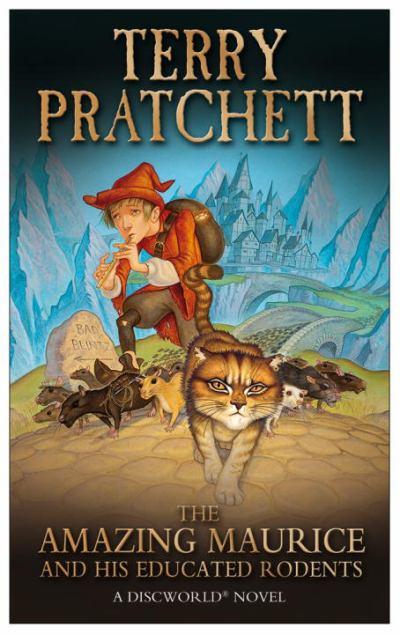
What's Elizabeth Reading? ...Terry Pratchett

First off, I would like you all to know that I was not attempting to disparage E.B. White in any way by using Stuart Little in a negative context.  I have not read Stuart Little.  However, I have read Elements of Style and have the utmost respect for White.

That being said, I was pleasantly surprised by this book.  It was like Tom Sawyer meets folk tales while folk tales is having a philosophical discussion with Jiminy Cricket over lunch, though I'm sure that description leaves out a whole host of people whom Pratchett invited to have lunch with them, too.  The talking animals were weird for the first little bit, but then I got used to them and the story moved along swimmingly.  At some points, it had me laughing out loud.

If Pratchett sat down with me and asked me what I would change about the book, I think the only thing I would tell him would be to hide the philosophy a little better.  While the story held it up well, I guess I'm not a huge fan of didactic novels, or novels that openly ponder the big questions in life.  I know I can learn from everything I read, and I like to look for the lessons on my own.  I don't want someone to hand me a moral.  Then again, that's just me.  Maybe the moral thing fits the age group (pre-teen, by the way).  I'm not an expert.

This book was not at all similar to the Bell book I was reading at the same time.  I was switching back and forth - fifty pages here, fifty pages there - and found myself excited to pick up each in turn.  At the same time, I was disappointed to be putting this one down each time I swapped to the other.  It was an enjoyable read.  The writing was upbeat and fun, and it was an interesting twist on the Pied Piper that I never would have thought of.